
Most SaaS companies do not fail at SEO because they publish too little content. They fail because they publish the wrong type of content.
They write long blogs for broad keywords. They chase traffic from people who are still learning. They create “what is” articles, general guides, and trend-based posts. These can bring visitors, but many of those visitors are not ready to book a demo, start a free trial, compare tools, or speak with sales.
For SaaS companies, SEO should not be treated like a blog machine. It should be treated like a buyer journey system.
A strong SaaS SEO strategy helps the right people find your software at the exact moment they are searching for a solution. That includes founders looking for a tool, managers comparing vendors, operations teams searching for integrations, and decision-makers checking pricing, security, features, and implementation details.
This is why SaaS SEO is different from normal SEO.
A restaurant, clinic, or local service business may only need strong local visibility and service pages. A SaaS business needs something deeper: product-led content, use-case pages, integration pages, comparison pages, alternative pages, technical SEO, trust-building content, and conversion-focused landing pages.
Google also recommends creating helpful, reliable, people-first content instead of content made mainly to manipulate search rankings. It specifically encourages original value, clear structure, expertise, trust, and pages that leave visitors feeling satisfied.
For SaaS companies, that means one simple thing: do not write only for keywords. Write for buyers who are trying to make a decision.
What Is SaaS SEO?
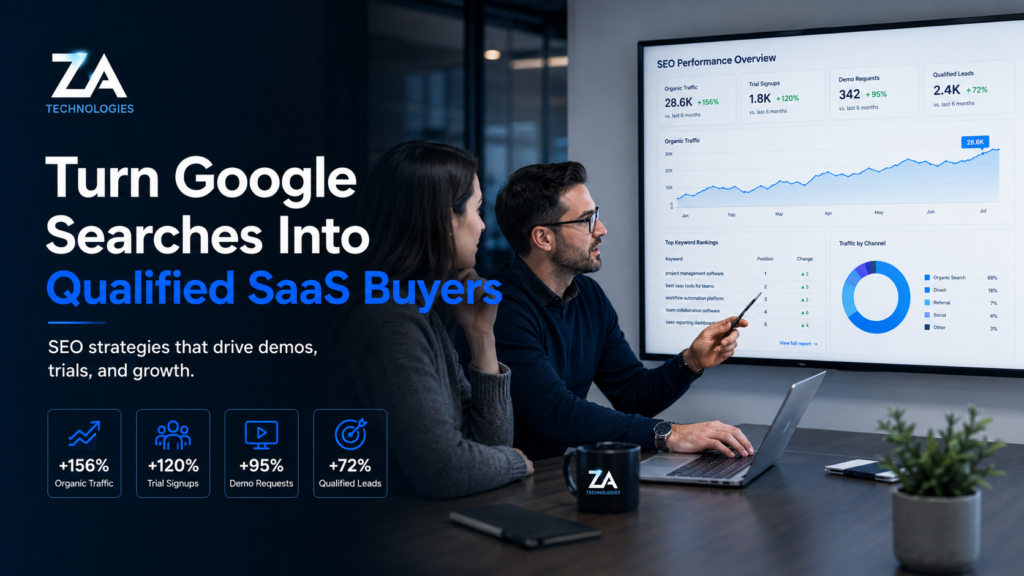
SaaS SEO is the process of helping software companies attract organic traffic from search engines and turn that traffic into product signups, demos, trials, qualified leads, and long-term customers.
But SaaS SEO is not only about ranking blog posts.
It includes:
- Product pages
- Feature pages
- Use-case pages
- Industry pages
- Integration pages
- Comparison pages
- Alternative pages
- Pricing-related content
- Security and compliance content
- Help center content
- Case studies
- Technical SEO
- Internal linking
- Conversion optimization
A good SaaS SEO strategy connects search demand with the actual questions buyers ask before choosing software.
Someone searching “what is workflow automation” may only be learning.
Someone searching “best workflow automation software for agencies” is closer to a decision.
Someone searching “Zapier alternative for client onboarding automation” may be even closer to buying.
All three searches matter, but they should not be treated the same.
Why SaaS SEO Needs a Different Strategy
SaaS buyers usually do not purchase after reading one blog post.
They compare options. They check pricing. They read reviews. They ask their team. They test a demo. They search for alternatives. They check integrations. They worry about migration, security, support, and whether the tool will actually fit their workflow.
That means SaaS SEO needs to answer different levels of intent.
A normal blog strategy may focus on traffic. A SaaS SEO strategy should focus on pipeline.
The goal is not just “more visitors.”
The goal is better-fit visitors who are more likely to become customers.
This is where many SaaS competitors have a gap. They publish educational content, but they do not build enough buyer-intent pages. Recent SaaS SEO playbooks consistently highlight bottom-of-funnel pages such as alternatives, comparisons, integrations, pricing, and use-case pages as important for attracting buyers who are already evaluating solutions.
If a SaaS company only writes educational blogs and ignores decision-stage content, competitors will capture buyers when they are ready to choose.
Start With Search Intent, Not Search Volume
One of the biggest mistakes in SaaS SEO is choosing keywords only because they have high search volume.
High search volume does not always mean high business value.
For example:
- “What is CRM” may have more searches.
- “Best CRM for small consulting firms” may have fewer searches.
- “HubSpot alternative for B2B SaaS startups” may have even fewer searches.
But the third search may bring a much more serious buyer.
That is why SaaS companies should divide keywords by intent:
Informational Intent
These are early-stage searches. The person is learning about a problem or concept.
Examples:
- What is SaaS automation?
- How does CRM software work?
- What is customer onboarding?
- Benefits of workflow automation
These keywords are useful for awareness, but they usually do not convert quickly.
Commercial Investigation Intent
These searches show that the buyer is comparing options.
Examples:
- Best CRM software for startups
- Top customer onboarding tools
- Best project management software for SaaS teams
- Workflow automation software comparison
These are stronger because the searcher is actively looking at solutions.
Bottom-of-Funnel Intent
These searches are closest to revenue.
Examples:
- [Competitor] alternatives
- [Tool A] vs [Tool B]
- [Software category] pricing
- [Software] integration with Salesforce
- Best [software] for [specific use case]
These searches often have lower volume, but they attract people who already understand the problem and are looking for the right tool.
A strong SaaS SEO strategy should not begin with the biggest keywords. It should begin with the keywords most connected to revenue.
Build SaaS SEO Around Buyer Pain Points
SaaS buyers search because something is not working.
They are not just looking for information. They are trying to solve a painful business problem.
Common SaaS buyer pain points include:
- Too much manual work
- Slow team communication
- Poor reporting
- Missed follow-ups
- High customer support load
- Scattered data
- Low user adoption
- Expensive tools
- Weak integrations
- Poor visibility into performance
- Confusing workflows
- Time wasted on repetitive tasks
Your SEO content should speak directly to these problems.
Instead of writing only:
“Benefits of CRM Software”
Write:
“Why Sales Teams Lose Leads in Spreadsheets and How CRM Automation Fixes It”
Instead of:
“Project Management Software Guide”
Write:
“How Growing SaaS Teams Can Stop Missing Deadlines With Better Project Workflow Visibility”
Instead of:
“Customer Support Automation”
Write:
“How SaaS Companies Can Reduce Support Tickets Without Making Customers Feel Ignored”
These titles are stronger because they connect with real problems, not just software categories.
The SaaS SEO Funnel: What Pages You Actually Need
A proper SaaS SEO funnel should cover the full buyer journey, but the structure should not be random.
Here is a practical page model.
1. Problem-Aware Blog Posts
These posts target users who know they have a problem but may not know the solution yet.
Examples:
- Why customer onboarding takes too long
- How manual reporting slows down SaaS teams
- Why support tickets increase after product launch
- How scattered customer data hurts retention
These pages build trust and attract early-stage traffic.
But they should not end with a weak CTA like “contact us.” Instead, they should guide readers toward a relevant solution page, checklist, demo, or use-case page.
2. Use-Case Pages
Use-case pages are very important for SaaS SEO because buyers often search based on what they want to accomplish.
Examples:
- Client onboarding automation software
- Lead management software for agencies
- Customer support automation for SaaS
- Workflow automation for finance teams
- Internal knowledge base software for remote teams
A use-case page should explain:
- The pain point
- Who the use case is for
- How the software solves the problem
- What features support it
- What workflows improve
- What results users can expect
- Which integrations matter
- What makes the solution different
This type of page attracts users who are closer to action than general blog readers.
3. Feature Pages
Feature pages help buyers understand what your product actually does.
Examples:
- AI lead scoring
- Automated reporting
- Client portal
- CRM integration
- Approval workflows
- Real-time analytics
- Role-based access
Many SaaS companies make feature pages too thin. They write a few lines and add screenshots. That is not enough.
A good feature page should answer:
- What does this feature do?
- Why does it matter?
- What problem does it solve?
- Who uses it?
- How does it work?
- What makes it better than the manual process?
- What related features support it?
Feature pages should also link to related use cases and product pages.
4. Integration Pages
Integration pages are often ignored, but they can attract very high-intent buyers.
A buyer may already use tools like Salesforce, HubSpot, Slack, Shopify, Stripe, QuickBooks, Zapier, Notion, Google Workspace, or Microsoft Teams. Before choosing new software, they want to know whether it connects with their current systems.
Examples:
- CRM integration with Slack
- SaaS billing integration with Stripe
- Project management software with Google Calendar
- Customer support tool integration with HubSpot
Integration pages should explain:
- What the integration does
- What data syncs
- Which workflows improve
- Who needs it
- Setup requirements
- Common use cases
- Limitations
- Related integrations
This is also important because modern SaaS buyers want tools that fit into their existing workflow, not tools that create more manual work.
5. Comparison Pages
Comparison pages help buyers who are actively evaluating choices.
Examples:
- Tool A vs Tool B
- Best alternative to Tool A
- Tool A vs Tool B for agencies
- Tool A vs Tool B pricing comparison
Many SaaS companies avoid comparison pages because they feel uncomfortable mentioning competitors. But buyers are already searching for these comparisons. If your company does not answer, someone else will.
A strong comparison page should be honest. It should not attack competitors. It should clearly explain:
- Who each tool is best for
- Feature differences
- Pricing differences
- Use-case fit
- Setup effort
- Integrations
- Support
- Limitations
- When to choose each option
This builds trust because the reader feels helped, not sold to.
6. Alternative Pages
Alternative pages attract buyers who are unhappy with a current tool or looking for a better fit.
Examples:
- Best [competitor] alternatives
- [Competitor] alternative for small teams
- Affordable alternative to [competitor]
- [Competitor] alternative with better onboarding
Current SaaS SEO research and market discussion repeatedly point to alternatives pages as one of the strongest buyer-intent page types because they meet users at a decision stage, not just an awareness stage.
An alternative page should answer:
- Why people look for alternatives
- What gaps the competitor may have
- Which users still fit that competitor
- Which users need another option
- How your product compares
- What migration looks like
- What the buyer should check before switching
The best alternative pages feel balanced and practical.
7. Pricing and Cost Pages
Many SaaS companies hide pricing because they want prospects to book a demo first.
That can work for enterprise sales, but it can also create friction. Buyers often search for pricing before speaking to sales. If they cannot find clear information, they may leave.
A pricing page or pricing guide can target searches like:
- How much does [software category] cost?
- [Software] pricing
- Best affordable [software category]
- [Competitor] pricing alternative
- SaaS implementation cost
Even if exact pricing cannot be shown, the page can explain:
- Pricing factors
- Plans
- User seats
- Setup fees
- Implementation cost
- Add-ons
- Support levels
- When custom pricing applies
This helps buyers qualify themselves.
8. Security and Trust Pages
For B2B SaaS, security content can influence serious buyers.
A manager may like the product, but IT, legal, finance, or compliance teams may need answers before approval.
Searchable trust topics include:
- SaaS data security
- Role-based access control
- Data privacy
- SOC 2 readiness
- GDPR compliance
- Secure API integration
- Data backup and recovery
- User permissions
- Enterprise security checklist
These pages may not bring huge traffic, but they support conversions.
How to Find High-Intent SaaS Keywords
A practical SaaS keyword strategy should begin with your product, not with a keyword tool.
Start by listing:
- Your product category
- Main features
- Customer types
- Industries served
- Problems solved
- Competitors
- Integrations
- Use cases
- Pricing objections
- Sales questions
- Support questions
Then convert those into keyword patterns.
Useful SaaS keyword patterns include:
- Best [software category] for [industry]
- [Software category] for [team type]
- [Competitor] alternative
- [Tool A] vs [Tool B]
- [Software category] pricing
- [Software category] integration with [tool]
- How to automate [specific workflow]
- Software to manage [specific problem]
- [Industry] workflow automation software
- [Feature] software for [use case]
This is how you find keywords that are closer to revenue.
Do not ignore low-volume keywords. In SaaS SEO, a keyword with 30 monthly searches can be valuable if the searcher is ready to buy.
Searchable SaaS Blog Headings That Attract Better Buyers
A blog can still be powerful, but the headings need to match what people actually search.
Instead of using generic headings like “Benefits” or “Conclusion,” use headings that answer real buyer questions.
Examples:
- Why SaaS SEO Is Different From Traditional SEO
- How SaaS Companies Can Rank for High-Intent Keywords
- Which SEO Pages Generate the Most SaaS Demos?
- How to Build SaaS Comparison Pages Without Sounding Biased
- Why Integration Pages Matter for SaaS SEO
- How to Turn Product Features Into Searchable Landing Pages
- What SaaS Buyers Search Before Booking a Demo
- How to Measure SaaS SEO Beyond Traffic
- Why Top-of-Funnel Blogs Do Not Always Convert
- How AI Search Is Changing SaaS Content Strategy
These headings are more useful because they help both readers and search engines understand the page clearly.
Google’s AI search guidance also recommends creating unique, valuable, non-commodity content, organizing pages with clear headings, and maintaining a strong technical structure.
Competitor Gap: What Most SaaS SEO Blogs Miss
Many SaaS SEO guides explain the basics:
- Do keyword research
- Write blogs
- Build backlinks
- Improve technical SEO
- Track rankings
These are useful, but not enough.
The biggest gap is that many guides do not explain how SaaS SEO connects to product positioning and buyer intent.
Here are the gaps your content should fill:
Gap 1: They Focus Too Much on Traffic
Traffic is useful, but SaaS companies need qualified traffic.
A SaaS company can get thousands of visitors from broad informational posts and still get very few demos. The better strategy is to build content around buying moments.
Gap 2: They Ignore Product-Led SEO
Product-led SEO means your content is connected to what the software actually does.
For example, if the product helps automate onboarding, the SEO content should not only talk about “business productivity.” It should show onboarding workflows, templates, examples, screenshots, comparison points, and integration paths.
Gap 3: They Do Not Build Enough Decision Pages
Many competitors publish blogs but do not create enough:
- Alternative pages
- Comparison pages
- Pricing guides
- Use-case pages
- Integration pages
- Security pages
These pages often help buyers move closer to action.
Gap 4: They Treat AI Search Like a Separate Trick
Some blogs now talk about AEO or GEO like it is a completely new replacement for SEO. But Google’s own guidance says optimizing for generative AI search is still part of search optimization, and foundational SEO still matters.
The practical takeaway is simple: create better pages, clearer structure, original experience-based content, strong internal links, useful visuals, and crawlable technical foundations.
Gap 5: They Do Not Connect SEO With Sales Questions
Your sales calls are a keyword goldmine.
If prospects keep asking the same questions, those questions should become SEO content.
Examples:
- Is this software easy to migrate to?
- How long does implementation take?
- Can it integrate with our CRM?
- Is it secure for client data?
- What makes it different from [competitor]?
- Can small teams use it?
- What happens after the free trial?
- Is support included?
These questions are closer to revenue than many high-volume blog keywords.
SaaS SEO Content Architecture: How to Structure the Website
A strong SaaS SEO structure should feel like a clean map.
A simple structure can look like this:
Product Page
This explains the main product and its value.
Feature Pages
These explain specific capabilities.
Use-Case Pages
These explain how different teams or industries use the product.
Integration Pages
These explain how the product connects with other tools.
Comparison Pages
These help buyers compare options.
Alternative Pages
These help buyers who are considering switching.
Blog Content
This supports education, pain-point searches, and internal linking.
Case Studies
These prove results and build trust.
Help Center
This supports existing users and captures long-tail queries.
This structure makes it easier for users to move from learning to comparing to taking action.
It also helps Google understand the website’s topical authority.
Internal Linking Strategy for SaaS SEO
Internal linking is not only an SEO task. It is a user journey task.
Every page should help the reader take the next logical step.
For example:
- A blog about manual onboarding problems should link to a client onboarding use-case page.
- A use-case page should link to relevant features.
- A feature page should link to integrations.
- An integration page should link to comparison or demo pages.
- A comparison page should link to pricing, case studies, or contact.
- A technical blog should link to security or API pages.
For ZA Technologies, this blog can naturally connect with existing content and services such as SEO services, digital marketing, website development, software development, product strategy, and digital transformation. ZA already has SEO-related content covering business SEO, SEO services, SEO companies, SEO consultants, and SEO services in Canada.
Suggested internal links for this blog:
- Link SEO services to ZA’s SEO services guide.
- Link digital marketing strategy to ZA’s digital transformation or marketing-related pages.
- Link software development to ZA’s software development service page.
- Link product strategy to ZA’s product strategy service page.
- Link website development to ZA’s website development pages.
- Link contact ZA Technologies near the final CTA.
Technical SEO for SaaS Websites
SaaS websites often have technical SEO issues because they use modern frameworks, dynamic pages, gated content, app subdomains, JavaScript rendering, and complex product structures.
Important technical checks include:
- Can Google crawl the important pages?
- Are pages indexable?
- Is JavaScript hiding important content?
- Are product and feature pages loading fast?
- Are canonical tags correct?
- Is the sitemap clean?
- Are duplicate pages controlled?
- Are international pages using correct hreflang?
- Are pricing and comparison pages easy to access?
- Are Core Web Vitals acceptable?
- Is schema markup used where helpful?
- Are blog and product pages internally linked?
Google’s AI search guidance confirms that technical clarity still matters because Google Search needs to crawl and process pages before they can appear in Search or generative AI features.
For SaaS companies, technical SEO is not optional. If your best pages cannot be crawled, rendered, indexed, or understood, the content will not perform properly.
How AI Search Changes SaaS SEO
AI search has changed how people discover software.
Some users still search on Google, read blogs, and compare websites. Others now ask AI tools for recommendations, comparisons, use cases, and explanations.
This does not mean SaaS SEO is dead. It means SaaS SEO needs to become more useful, more specific, and more trustworthy.
AI search systems often look for clear, structured, credible information. Pages with original insight, real examples, comparison clarity, product detail, and strong topical coverage have a better chance of being useful in this environment.
Research on Google AI Overviews has shown that AI-generated answers can change traffic patterns and reduce clicks for some informational content, especially when the summary satisfies the searcher without needing a website visit.
For SaaS companies, this makes bottom-of-funnel SEO even more important. A simple informational answer may be summarized by AI. But buyers still need product pages, comparisons, pricing, demos, migration details, security information, and proof before making a decision.
SaaS SEO Metrics That Actually Matter
Do not measure SaaS SEO only by organic traffic.
Traffic is useful, but it can be misleading.
Better SaaS SEO metrics include:
- Organic demo requests
- Free trial signups
- Qualified leads
- Assisted pipeline
- Keyword rankings for BOFU terms
- Traffic to comparison pages
- Traffic to integration pages
- Trial-to-paid conversion from organic
- Organic customer acquisition cost
- Content-assisted revenue
- Search visibility for competitor terms
- Branded search growth
- Product page engagement
- Organic users who return later through direct or branded search
A blog post with 10,000 visitors and no demos may be less valuable than an integration page with 300 visitors and 10 qualified leads.
This is why SaaS SEO reporting should connect to CRM and analytics, not only Search Console.
A Practical 90-Day SaaS SEO Plan
Here is a simple but strong starting plan.
Days 1–15: SEO and Buyer Journey Audit
Review:
- Current rankings
- Traffic sources
- Best converting pages
- Pages with traffic but no leads
- Missing feature pages
- Missing use-case pages
- Missing comparison pages
- Missing integration pages
- Technical SEO issues
- Internal linking gaps
- Sales questions
- Competitor page structure
The goal is to understand where buyers are dropping off.
Days 16–30: High-Intent Keyword Mapping
Build keyword clusters around:
- Product category
- Use cases
- Features
- Industries
- Competitors
- Alternatives
- Comparisons
- Integrations
- Pricing
- Security
- Implementation
Then assign each cluster to a page type.
Do not turn every keyword into a blog. Some keywords deserve landing pages.
Days 31–60: Build Buyer-Intent Pages
Create or improve:
- 2 use-case pages
- 2 feature pages
- 1 comparison page
- 1 alternative page
- 1 integration page
- 1 pricing or cost guide
- 2 problem-aware blogs
Each page should include clear CTAs, internal links, FAQs, product relevance, and trust signals.
Days 61–90: Improve Technical SEO and Conversion
Fix:
- Slow pages
- Weak internal links
- Thin product pages
- Missing schema
- Duplicate pages
- Poor mobile experience
- Weak CTAs
- Unclear demo paths
- Missing case studies
- Confusing navigation
Then track which pages bring qualified traffic and which ones need improvement.
SaaS SEO Content Ideas That Can Attract High-Intent Buyers
Here are searchable content ideas that work well for SaaS companies:
- Best [software category] for [specific team]
- [Competitor] alternatives for [specific use case]
- [Tool A] vs [Tool B]: Which is better for [audience]?
- How to automate [workflow] without adding more tools
- [Software category] implementation guide
- [Software category] pricing: what affects cost?
- How to migrate from [competitor] to [your product category]
- Best [software category] integrations for [industry]
- How [industry] teams use [software category] to save time
- [Feature] software for [pain point]
- Why [manual process] slows down growth
- How to choose [software category] for a growing team
- What to look for before buying [software category]
- [Software category] checklist for [role]
- How to reduce [pain point] with [software category]
These topics work because they connect with real search behavior and buyer questions.
Final Thoughts
SaaS SEO is not about publishing more blogs than your competitors. It is about building the right pages for the right buyers at the right stage of their decision.
A strong SaaS SEO strategy should begin with buyer pain points, high-intent keywords, product-led content, and a clear website structure. It should include educational blogs, but it should not depend only on them. Use-case pages, feature pages, integration pages, comparison pages, alternative pages, pricing content, and trust pages often do more to support revenue.
The SaaS companies that win organic search are usually not the ones with the most content. They are the ones with the clearest answers.
They understand what buyers are searching for.
They explain the product honestly.
They answer objections before the sales call.
They connect content with real use cases.
They make the next step easy.
That is how software companies can attract high-intent buyers from Google and turn organic search into a real growth channel.


