

AI Strategy Consulting: A Complete Guide for Executives

AI Strategy Consulting: A Complete Guide for Executives

Every board deck now mentions AI, yet many executives still lack a concrete, fundable plan. Budgets get fragmented across pilots, vendors overpromise, and internal teams argue about priorities. AI strategy consulting exists to turn that noise into a clear, staged roadmap tied to measurable business value.

AI strategy consulting focuses on connecting machine learning, generative models, and automation to revenue, cost, and risk outcomes. Instead of starting with tools, consultants begin with your P&L, customer journeys, and regulatory constraints. They translate AI ambition into a portfolio of initiatives, each with quantified impact, dependencies, and ownership.

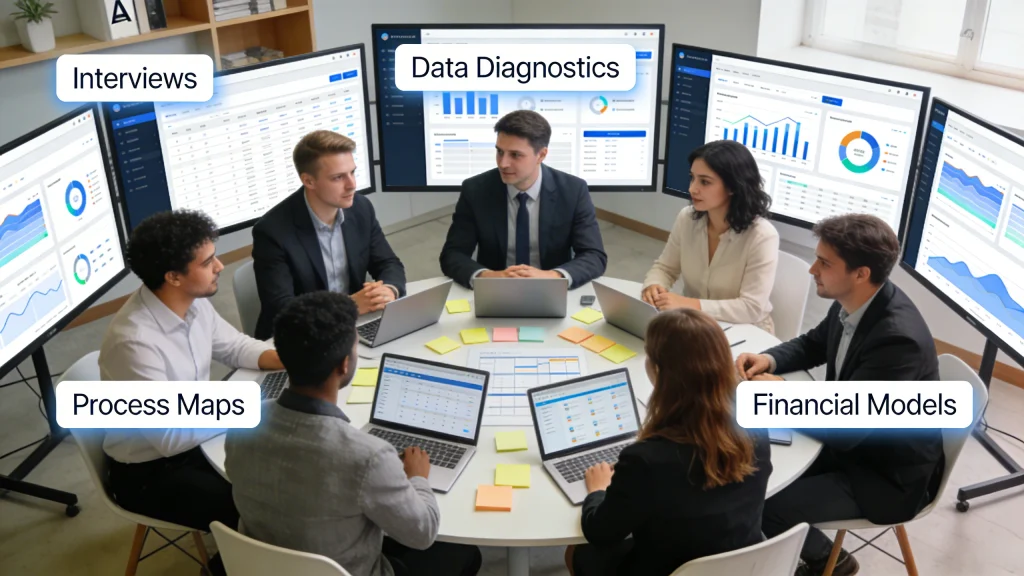
Effective AI consulting engagements typically run eight to twelve weeks and combine interviews, data diagnostics, and financial modeling. Executives gain a prioritized roadmap, investment scenarios, and a governance model that aligns business, IT, risk, and compliance. This guide explains how those pieces fit together so you can engage consultants from a position of strength.

Used well, AI strategy consulting helps you avoid scattered proofs of concept and instead build a repeatable capability. You will see how to select partners, challenge their assumptions, and measure whether the work actually changes how your organization allocates capital and manages risk.

1
ai strategy consulting

What Is AI Strategy Consulting and Why It Matters Now

What Is AI Strategy Consulting and Why It Matters Now

The urgency around AI strategy consulting comes from converging pressures: competitive disruption, rapid advances in generative models, and rising expectations from boards and regulators. Consultants help executives distinguish hype from real advantage, clarifying where AI can reshape customer experience, operations, and products while staying within acceptable risk, compliance, and ethical boundaries.

AI strategy consulting is a business-first discipline that links advanced analytics, machine learning, and generative AI to concrete objectives. Unlike project-based IT work, it starts with strategic questions: where to compete, which processes to transform, and how much risk your board accepts. Timing matters because competitors are already embedding AI into pricing, service, and supply chains.

How AI Strategy Consulting Differs from Generic IT Consulting

Traditional IT consulting often centers on system selection and implementation milestones, such as rolling out an ERP in eighteen months. AI strategy consulting instead frames decisions around value pools and uncertainty. Consultants model scenarios, for example, a 3% margin lift from dynamic pricing versus a 20% call volume reduction from virtual agents, then recommend where to experiment and where to scale.

Why the Market Window Is Narrowing

Competitive advantage from AI frequently follows an S-curve: early adopters capture disproportionate gains, then benefits commoditize. McKinsey estimates that leaders in data-driven decision-making are 23 times more likely to acquire customers. Without a structured AI strategy, organizations risk becoming late followers, forced to match competitors’ capabilities at higher cost and under tighter regulatory scrutiny.

2
ai strategy

Core Components of Effective AI Strategy Consulting Engagements

Robust AI consulting engagements follow a repeatable structure rather than ad hoc workshops. Consultants typically invest the first two to three weeks in discovery, mapping your strategic objectives, processes, and data assets. They then run targeted analyses and design sessions to convert insights into a set of prioritized initiatives, with explicit trade-offs and quantified assumptions.

Core Components of Effective AI Strategy Consulting Engagements

A strong AI strategy culminates in a prioritized use-case portfolio, not a vague vision. By scoring opportunities on value, feasibility, risk, and time to benefit, executives can stage investments over eight to twelve weeks and beyond. This portfolio becomes the backbone for funding decisions, talent planning, and technology roadmaps.

Vision, Use-Case Discovery, and Data Readiness

Vision setting clarifies where AI should play: revenue growth, cost optimization, or risk mitigation. Use-case discovery workshops might review thirty to fifty ideas across functions, quickly filtering those lacking data or sponsorship. Data readiness assessments examine completeness, latency, and quality; for example, evaluating whether order data has less than 2% missing values and updates within fifteen minutes.

Capability, Operating Model, and Risk Assessment

Consultants also assess people and process maturity. They may score analytics capabilities across dimensions like leadership support, tooling, and skills on a one-to-five scale. Operating model reviews identify whether AI teams should be centralized, federated, or embedded. Risk assessments consider model explainability, auditability, and alignment with regulations like GDPR, HIPAA, or sector-specific guidelines.

3

Aligning AI Strategy Consulting with Business and Operating Models

Aligning AI Strategy Consulting with Business and Operating Models

Aligning AI strategy with the operating model is essential for impact. Rather than isolated pilots, leading organizations embed AI into core value streams, decision rights, and technology platforms. Consultants help translate high-level ambition into specific changes in roles, processes, and governance so that AI solutions can scale reliably across the enterprise.

AI initiatives fail when they ignore how value actually flows through your organization. Effective AI strategy consulting begins with your business model: where revenue originates, which cost buckets dominate, and how risk is priced. Consultants then map AI opportunities onto these levers, ensuring every proposed use case has a clear link to financial statements and customer outcomes.

Mapping AI to Revenue, Cost, Risk, and Experience

Consultants often build a value tree that decomposes EBITDA into drivers like acquisition, churn, conversion, and unit cost. For instance, an AI-based churn model might target a 2% absolute reduction, translating into specific annual revenue preservation. Similarly, fraud detection models can be tied to basis-point reductions in loss ratios, with sensitivity analyses for false positives and operational workload.

Fitting AI into Existing Operating and Governance Models

Operating models determine where AI can be embedded with minimal disruption. If your organization already uses shared services for finance or HR, AI pilots may start there to leverage standardized processes and data. Governance frameworks, including risk committees and architecture boards, must be adapted to review AI models, monitoring drift, bias, and performance thresholds quarterly or even monthly.

4

From AI Strategy Consulting to a Prioritized Use-Case Portfolio

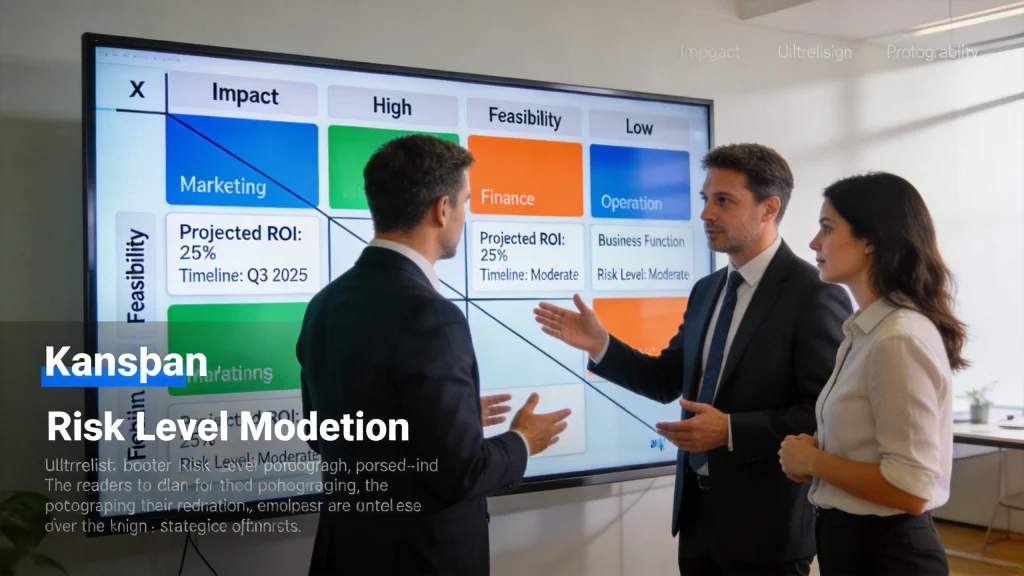
Brainstorming generates enthusiasm but not investment decisions. AI strategy consulting translates a long list of ideas into a structured portfolio, using scoring models and financial projections. Consultants typically evaluate each use case along dimensions such as business value, technical feasibility, data availability, and risk, then create a heatmap to highlight quick wins and strategic bets.

From AI Strategy Consulting to a Prioritized Use-Case Portfolio

Effective AI strategy engagements blend qualitative insight with quantitative rigor. Consultants typically run stakeholder interviews, assess data quality and architecture, map critical processes, and build financial models. Together, these activities reveal where AI can automate, augment, or reinvent work, and what level of investment is justified by measurable business outcomes.

Scoring Frameworks for AI Use Cases

Scoring frameworks assign numeric values, often from one to five, to capture potential impact and difficulty. A customer support chatbot might score four on value, due to 15% expected ticket deflection, but two on feasibility if knowledge articles are inconsistent. Summed scores create a ranking, while separate risk ratings flag initiatives requiring additional governance or regulatory engagement.

Example Portfolio Comparison Across Use Cases

Consultants often summarize candidate use cases in a comparative table to support executive decisions. The table below illustrates how four initiatives might be assessed on value, feasibility, risk, and estimated payback period. Numbers are directional, but they show how AI consulting companies structure trade-offs between short-term savings and long-term strategic differentiation.

Use CaseValue Score (1-5)Feasibility Score (1-5)Risk Level (1-5)Payback Period (months)
Customer churn prediction5439
Dynamic pricing engine43412
AI customer support chatbot3426
Predictive maintenance for equipment42315
Automated invoice processing3525

The resulting portfolio usually includes three buckets: quick wins with payback under twelve months, platform-building initiatives that improve data or infrastructure, and transformative bets. Executives can then phase funding, linking tranche releases to milestones such as model accuracy thresholds, adoption rates, and realized savings against baseline forecasts.

5

Building an AI Roadmap: Governance, Talent, and Technology

Once priorities are clear, the roadmap answers who does what, in which sequence, and with which enabling capabilities. AI consulting engagements typically produce a twelve-to-thirty-six-month plan that sequences pilots, platform investments, and scaling waves. The roadmap balances ambition with constraints in budget, talent, and regulatory oversight, avoiding unrealistic parallel initiatives.

Building an AI Roadmap: Governance, Talent, and Technology

Governance and Operating Guardrails

Governance frameworks define decision rights, escalation paths, and approval criteria. For example, a model risk committee might review any production model affecting more than $5 million in annual revenue. Policies specify documentation standards, fairness metrics, and monitoring cadences. Clear guardrails reduce friction between innovation teams and risk, enabling faster approvals without sacrificing control.

Talent Models and Technology Architecture Choices

Consultants help decide whether to build internal data science teams, rely on AI consulting companies, or adopt hybrid models. They also recommend architecture patterns, such as using a central feature store, MLOps pipelines, and vector databases for generative AI. Technology choices factor in licensing costs, cloud commitments, latency requirements, and integration complexity with existing core systems.

6

Choosing the Right AI Strategy Consulting Partner

Choosing the Right AI Strategy Consulting Partner

Not all AI consulting providers are equipped to link algorithms with board-level decisions. Some firms emphasize technical experimentation, while others bring deep sector knowledge but limited hands-on implementation experience. As an executive sponsor, you need to evaluate whether a partner can challenge assumptions, quantify value, and transfer capabilities rather than creating long-term dependence.

Key Evaluation Criteria and Questions

Strong partners can demonstrate industry-specific case studies with measurable outcomes, such as a 10% reduction in claims leakage or 5% uplift in cross-sell. They should show a repeatable methodology, from discovery through scaling, and be transparent about failure rates. Ask how they handle data privacy, model explainability, and handover to internal teams after the engagement.

  • Request at least two references with quantified results, including baseline metrics, realized impact, and time-to-value.
  • Ask which roles will be on your project, their utilization rates, and how many similar engagements they have led.
  • Probe how they integrate with your IT, risk, and compliance stakeholders without creating parallel, conflicting processes.
  • Clarify intellectual property ownership, including models, code, and documentation, once the engagement concludes.
  • Review their approach to upskilling your staff so dependence on external AI consulting decreases over twelve months.
7

Measuring the Impact of AI Strategy Consulting Over Time

The value of AI strategy consulting is not the slide deck; it is the behavioral and financial change that follows. Measurement must therefore extend beyond project completion, tracking whether prioritized initiatives are funded, executed, and scaled. Executives should agree on a small set of KPIs and feedback loops before the engagement ends.

Measuring the Impact of AI Strategy Consulting Over Time

Execution, Outcome, and Capability KPIs

Execution metrics might include the percentage of roadmap initiatives with approved business cases within six months. Outcome metrics track realized benefits, such as incremental revenue, cost savings, or loss reductions versus baselines. Capability metrics evaluate internal maturity, for example, the number of teams using standardized MLOps pipelines or the proportion of decisions informed by AI-generated insights.

Insightful AI strategies show their value when capital allocation changes. If your investment committee still funds projects exactly as before, without favoring data-rich, AI-enabled initiatives, the consulting work has not shifted decision-making. Track how many new proposals include AI components, modeled impacts, and explicit risk assessments compared with prior years.

Feedback Loops and Continuous Refinement

Quarterly reviews should revisit the roadmap, comparing planned versus actual impact and adjusting priorities. External shocks, such as regulatory changes or new foundation models, may alter feasibility or risk scores. Maintaining a living portfolio, rather than a static plan, ensures AI consulting investments continue to align with evolving strategy, budgets, and operating constraints.

“We help businesses construct intelligent digital futures. Contact us today — we’ll recommend the best transformation strategy.”

Office
8621 201 St Suite 240, Langley Twp, BC V2Y 0G9
Phone:  
+1 (672)-232-0498
ZA Technologies
Privacy Overview

This website uses cookies so that we can provide you with the best user experience possible. Cookie information is stored in your browser and performs functions such as recognising you when you return to our website and helping our team to understand which sections of the website you find most interesting and useful.