

Artificial Intelligence is no longer limited to large technology companies. Businesses of all sizes are adopting AI to automate tasks, improve customer experiences, analyze data, and increase productivity. However, many organizations rush into AI projects without proper planning and end up disappointed with the results.
The problem is rarely the technology itself. Most AI initiatives fail because of poor planning, unrealistic expectations, weak data foundations, or a lack of alignment between business goals and technology decisions.
Understanding these common mistakes before investing in AI can save time, money, and frustration. This guide explains the most frequent AI implementation errors businesses make and how to avoid them.
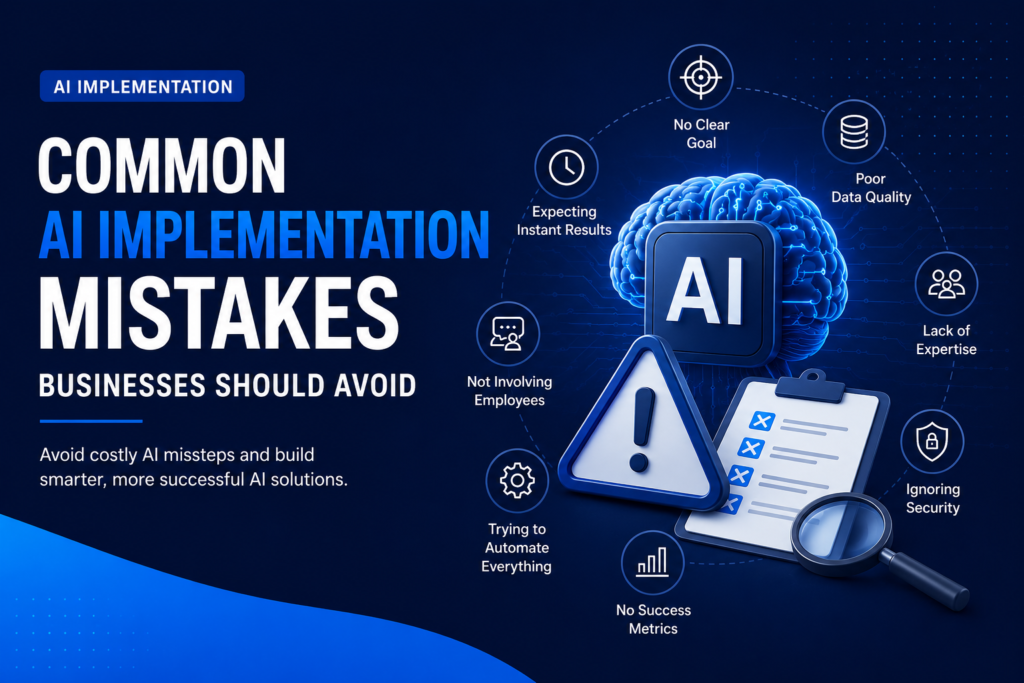
Starting with Technology Instead of Business Problems
One of the biggest mistakes organizations make is deciding to use AI before identifying a specific business problem.
Many business leaders hear success stories about AI and immediately begin looking for ways to implement it. They purchase tools, hire consultants, or launch projects without a clear objective.
Successful AI projects start with a business challenge, not a technology trend.
Examples include:
- Reducing customer support response times
- Automating repetitive administrative tasks
- Improving sales forecasting
- Enhancing product recommendations
- Detecting fraudulent transactions
When businesses focus on solving a real problem, it becomes much easier to measure success and generate value.
Expecting AI to Deliver Instant Results
AI is often marketed as a solution that can transform a business overnight. In reality, successful implementation requires planning, testing, training, and continuous improvement.
Organizations sometimes expect immediate returns after deploying an AI solution. When results take longer than expected, stakeholders lose confidence in the project.
AI systems learn from data and user interactions. Performance typically improves over time as models are refined and processes are optimized.
Businesses should view AI as a long-term investment rather than a quick fix.
Ignoring Data Quality Issues
AI systems depend on data. If the data is incomplete, inaccurate, outdated, or inconsistent, the results produced by AI will also be unreliable.
This is one of the most common reasons AI projects fail.
Before implementing any AI solution, businesses should evaluate:
- Data accuracy
- Data completeness
- Data consistency
- Data security
- Data accessibility
A company may invest thousands of dollars in advanced AI software, but poor data quality can prevent it from delivering meaningful outcomes.
Strong data management should always come before AI implementation.
Choosing the Wrong Use Case
Not every business process requires AI.
Some organizations attempt to apply AI to tasks that can be solved more efficiently with traditional software or workflow automation.
For example, a simple approval process may not require machine learning. Standard automation tools can often perform the same task at a lower cost and with less complexity.
Businesses should evaluate whether AI is genuinely needed before committing resources.
The best AI use cases usually involve:
- Large amounts of data
- Pattern recognition
- Prediction and forecasting
- Natural language processing
- Complex decision support
If a problem does not require these capabilities, AI may not be the right solution.
Lack of Internal Expertise
Many companies underestimate the skills required to manage AI projects successfully.
AI implementation involves more than installing software. It requires expertise in data management, business processes, security, governance, integration, and performance monitoring.
Without proper knowledge, organizations may struggle to evaluate vendors, interpret results, or maintain systems after deployment.
Businesses do not necessarily need a large in-house AI team, but they should ensure access to experienced professionals who understand both the technology and business requirements.
Failing to Involve Employees Early
Employees often worry that AI will replace their jobs. If leadership introduces AI without communication or training, resistance can develop quickly.
Successful AI adoption depends heavily on employee engagement.
Staff members should understand:
- Why AI is being introduced
- How it will support their work
- What changes to expect
- What new skills may be required
Organizations that involve employees early in the process typically experience smoother adoption and better results.
AI should be positioned as a tool that helps people work more efficiently rather than as a replacement for human expertise.
Overlooking Data Privacy and Security
AI systems often process sensitive information, including customer data, financial records, and internal business documents.
Failing to address privacy and security requirements can create serious legal and operational risks.
Businesses should carefully evaluate:
- Data storage practices
- Access controls
- Regulatory compliance requirements
- Third-party vendor security standards
- Data retention policies
Security should be considered from the beginning of the project, not after deployment.
Organizations operating in regulated industries must pay particular attention to compliance requirements when implementing AI solutions.
Not Setting Clear Success Metrics
Some businesses launch AI projects without defining what success looks like.
Without measurable objectives, it becomes impossible to determine whether the investment is delivering value.
Before implementation, organizations should establish clear key performance indicators (KPIs).
Examples include:
- Reduction in processing time
- Increase in customer satisfaction scores
- Lower operational costs
- Improved lead conversion rates
- Reduced error rates
Tracking performance against defined metrics helps justify investment and identify areas for improvement.
Trying to Automate Everything
Another common mistake is attempting to automate entire business operations at once.
Large-scale AI transformations often introduce unnecessary complexity and increase project risks.
A more effective approach is to start with a focused use case, demonstrate measurable success, and gradually expand AI capabilities over time.
This approach allows businesses to:
- Learn from early implementation experiences
- Reduce risk
- Build employee confidence
- Improve adoption rates
- Generate faster returns
Small, successful projects often create the foundation for broader AI initiatives.
Choosing Vendors Based Only on Cost
Selecting an AI solution solely because it is inexpensive can lead to significant challenges later.
Low-cost solutions may lack:
- Scalability
- Security features
- Integration capabilities
- Vendor support
- Customization options
Businesses should evaluate vendors based on long-term value rather than upfront pricing alone.
A reliable partner should understand your industry, business objectives, and operational requirements.
The right AI solution should support growth rather than create limitations.
Neglecting Continuous Monitoring and Improvement
AI implementation is not a one-time project.
Business conditions change. Customer behavior evolves. Data patterns shift.
An AI model that performs well today may become less accurate over time if it is not monitored and updated.
Organizations should establish ongoing processes for:
- Performance monitoring
- Model evaluation
- Data quality reviews
- Security assessments
- System optimization
Continuous improvement helps ensure that AI investments continue to deliver value long after deployment.
Final Thoughts
AI has the potential to improve efficiency, reduce costs, enhance customer experiences, and support better decision-making. However, success depends on more than selecting the right technology.
Businesses that approach AI strategically are far more likely to achieve meaningful results. They start with clear business objectives, build strong data foundations, involve employees, establish measurable goals, and continuously optimize their systems.
The most successful organizations do not view AI as a magic solution. They treat it as a business tool that requires planning, governance, and ongoing management.
Avoiding these common implementation mistakes can significantly increase the chances of turning AI investments into measurable business outcomes.