

Building a digital product is exciting. Whether it is a mobile app, web application, SaaS platform, or internal business tool, every product starts with an idea. The challenge is turning that idea into something customers actually want to use.
Many businesses rush directly into development. They hire designers, assign developers, and begin building features immediately. At first, everything seems to move quickly. A few months later, budgets start increasing, deadlines slip, stakeholders disagree on priorities, and the final product looks very different from the original vision.
This happens more often than most people realize.
One of the biggest reasons projects fail is not poor coding or bad design. It is a lack of product strategy and roadmap planning.
A clear strategy and roadmap help teams understand what they are building, why they are building it, who it is for, and how success will be measured. More importantly, they reduce the risks that can derail a project before it reaches the market.
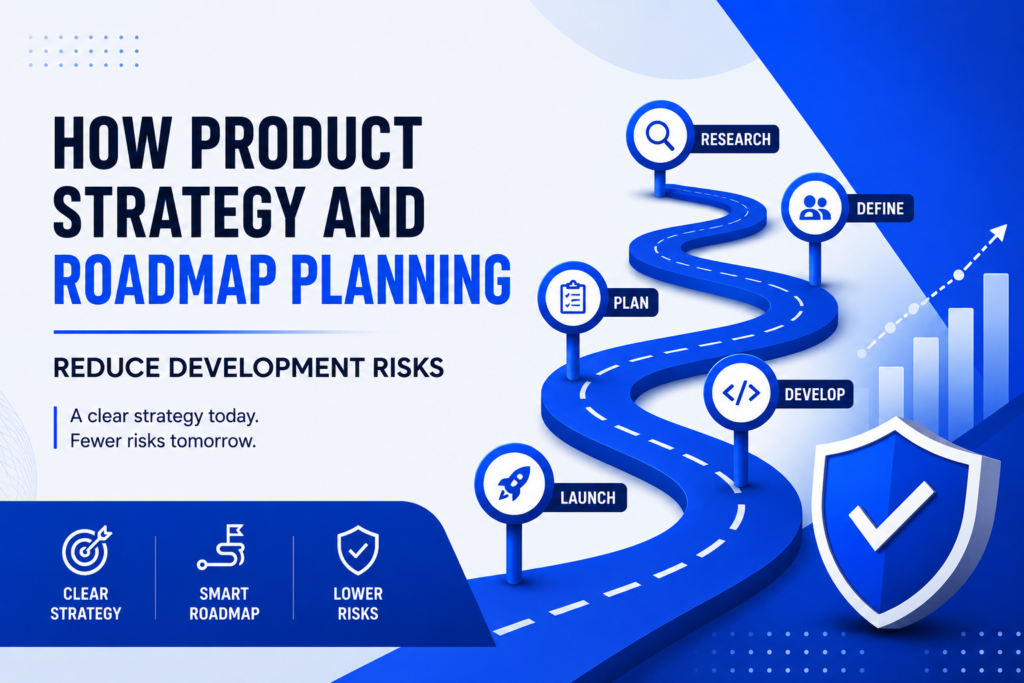
What Is Product Strategy?
Product strategy is the high-level plan that guides the development of a product.
It defines:
- The problem being solved
- The target audience
- The business objectives
- The product vision
- The key opportunities in the market
Think of product strategy as a blueprint before constructing a building. Without it, teams may build something impressive but not necessarily useful.
A strong product strategy answers questions such as:
- Who are our users?
- What pain points are we solving?
- Why would customers choose us over competitors?
- What business goals are we trying to achieve?
- How will we measure success?
These answers create alignment across the entire organization.
What Is a Product Roadmap?
A product roadmap is a practical plan that turns strategy into action.
While strategy explains the destination, the roadmap explains how to get there.
A roadmap typically includes:
- Major product goals
- Development phases
- Feature priorities
- Release timelines
- Dependencies
- Key milestones
The roadmap gives everyone involved a shared understanding of what will happen next.
Developers know what to build. Designers know what experiences to create. Stakeholders understand project priorities. Leadership gains visibility into progress.
Without a roadmap, teams often move in different directions.
Understanding Development Risks
Every product development project involves risk.
Some risks are technical. Others are financial, operational, or market-related.
Common development risks include:
Building Features Nobody Wants
One of the most expensive mistakes in product development is investing months into features that users do not need.
A product strategy helps teams validate customer problems before development begins.
Instead of guessing, decisions are based on research, user interviews, competitor analysis, and market insights.
Budget Overruns
Projects that lack clear priorities often suffer from scope creep.
New features are continuously added. Requirements change frequently. Development becomes unpredictable.
A roadmap establishes priorities and helps teams focus on delivering the most valuable features first.
This reduces unnecessary spending and keeps projects financially manageable.
Missed Deadlines
Many projects fail to launch on schedule because teams underestimate complexity.
Roadmap planning identifies dependencies, resource requirements, and potential bottlenecks early.
This creates more realistic timelines and reduces delays.

Team Misalignment
Different stakeholders often have different opinions about what should be built.
Marketing may prioritize one feature while engineering prefers another. Leadership may have completely different expectations.
A documented strategy provides a single source of truth.
Everyone works toward the same objectives.
How Product Strategy Reduces Development Risks
It Creates Clear Business Goals
Products without clear goals often become collections of random features.
A strategy forces businesses to define measurable outcomes.
Examples include:
- Increasing customer retention
- Generating subscription revenue
- Reducing operational costs
- Expanding into new markets
When goals are clear, every product decision can be evaluated against them.
This prevents unnecessary development work.
It Improves Decision-Making
Product teams make hundreds of decisions throughout development.
Without a strategy, these decisions are often based on opinions.
With a strategy, decisions are based on evidence and business objectives.
When a new feature request appears, teams can ask:
“Does this support our product goals?”
If the answer is no, resources can be allocated elsewhere.
It Helps Identify Risks Early
Early planning reveals potential challenges before they become expensive problems.
For example:
- Technical limitations
- Regulatory requirements
- Security concerns
- Integration challenges
- Resource shortages
Identifying these risks early allows teams to create solutions before development is affected.
It Aligns Stakeholders
Miscommunication is one of the leading causes of project failure.
A documented product strategy creates alignment across departments.
Everyone understands:
- Product vision
- Success metrics
- User needs
- Business priorities
This reduces confusion and improves collaboration.
How Roadmap Planning Reduces Development Risks
Prioritizes High-Impact Features
Not every feature delivers equal value.
Some features generate significant user benefits while others have minimal impact.
A roadmap helps teams prioritize features that contribute most to business and user goals.
This approach delivers value faster and reduces wasted effort.
Supports Incremental Development
Building everything at once is risky.
Modern product teams often use phased development.
For example:
Phase 1:
Launch an MVP with essential functionality.
Phase 2:
Collect user feedback.
Phase 3:
Improve features based on real-world usage.
Phase 4:
Scale the product.
This approach reduces risk because assumptions can be tested before larger investments are made.
Improves Resource Allocation
A roadmap provides visibility into upcoming work.
Project managers can allocate:
- Designers
- Developers
- QA specialists
- Product managers
more effectively.
Teams avoid resource conflicts and maintain productivity.
Enhances Transparency
Roadmaps make project progress visible.
Stakeholders can see:
- Completed milestones
- Upcoming priorities
- Development status
- Potential delays
Transparency reduces uncertainty and builds confidence throughout the organization.
The Role of Market Research in Risk Reduction
Market research plays a critical role in product strategy.
Many products fail because businesses assume they understand customer needs.
Research replaces assumptions with facts.
Effective market research helps teams understand:
- Customer pain points
- Industry trends
- Competitive landscape
- User expectations
- Pricing opportunities
The insights gained help shape both strategy and roadmap decisions.
Instead of building based on guesses, teams build based on evidence.
Why MVP Planning Matters
A Minimum Viable Product (MVP) is one of the most effective risk reduction tools available.
An MVP focuses on solving a core problem using only essential features.
Benefits include:
- Faster time to market
- Lower development costs
- Earlier customer feedback
- Reduced technical complexity
- Better validation of business ideas
Many successful products began as simple MVPs before expanding into larger platforms.
Launching early allows teams to learn from real users instead of relying solely on assumptions.
Common Mistakes Businesses Make
Starting Development Too Soon
Many organizations jump directly into development without conducting research or planning.
This often leads to expensive revisions later.
Creating Overly Detailed Roadmaps
Roadmaps should provide direction, not lock teams into rigid plans.
Flexibility is important because customer needs and market conditions can change.
Ignoring User Feedback
A roadmap should evolve based on real customer insights.
Ignoring feedback increases the risk of building the wrong solution.
Prioritizing Features Over Outcomes
Successful products focus on solving problems rather than simply adding features.
Every roadmap decision should connect back to user and business outcomes.
Best Practices for Effective Product Strategy and Roadmap Planning
To reduce development risks effectively:
- Start with user research.
- Define measurable business goals.
- Validate assumptions before development.
- Prioritize based on value and impact.
- Create a realistic roadmap.
- Review priorities regularly.
- Launch an MVP when possible.
- Monitor customer feedback continuously.
- Keep stakeholders aligned.
- Adjust plans based on new information.
These practices help teams stay focused while remaining adaptable.
Final Thoughts
Product development always involves uncertainty. No team can eliminate every risk. However, businesses can dramatically reduce risk through strong product strategy and roadmap planning.
A product strategy provides direction. A roadmap provides structure. Together, they help teams make smarter decisions, manage resources effectively, avoid costly mistakes, and build products that solve real customer problems.
The most successful digital products are rarely the result of luck. They are the result of careful planning, clear priorities, and a deep understanding of both business goals and user needs.
Before writing a single line of code, invest time in strategy and roadmap planning. The effort spent at the beginning of a project often determines whether the product succeeds or struggles after launch.