

Search is not the same as it was a few years ago.
People still use Google, but they do not search in the same simple way. They ask longer questions. They compare products directly. They expect faster answers. They use voice search, AI assistants, AI Overviews, chat-based search tools, and recommendation-style results. Instead of typing only “best SEO services,” a business owner may now ask:
“Which SEO service is best for a SaaS company that wants more demo requests from Google?”
That one change tells us a lot.
Search is becoming more conversational, more intent-based, and more answer-focused. For businesses, this means SEO services can no longer depend only on keywords, backlinks, and blog volume. Those things still matter, but they are not enough on their own.
In the age of smart search, SEO needs to help a business become the most helpful, trustworthy, and easy-to-understand answer for its audience.
Google’s own guidance says the same foundational SEO best practices still apply to AI features in Search, including crawlable content, technical accessibility, and helpful, reliable, people-first pages. But the way businesses create and structure content now needs to become much sharper.
What Is Smart Search?
Smart search means search engines and AI-powered systems are trying to understand the meaning behind a query, not just match exact words.
In traditional SEO, a page could rank by using the right keyword, writing enough content, and building authority. Today, search engines also look at context, user intent, page quality, structure, trust signals, topical depth, and whether the content actually satisfies the searcher.
Smart search includes:
AI Overviews in Google Search
AI Mode and conversational search experiences
Bing generative AI search features
Voice search and natural-language queries
Answer engines like ChatGPT, Perplexity, Gemini, and Copilot
Personalized and intent-based search results
Searches that mix text, image, product, local, and video results
Google expanded AI Overviews widely and introduced AI Mode to help users ask more complex, multi-step questions, not just simple keyword queries. Google also published a dedicated guide for optimizing for generative AI features in Search, which confirms that smart search is now part of the normal SEO conversation.
For businesses, this creates both a challenge and an opportunity.
The challenge is that thin, generic content is easier to ignore.
The opportunity is that truly helpful content can appear in more search experiences, not only traditional blue links.
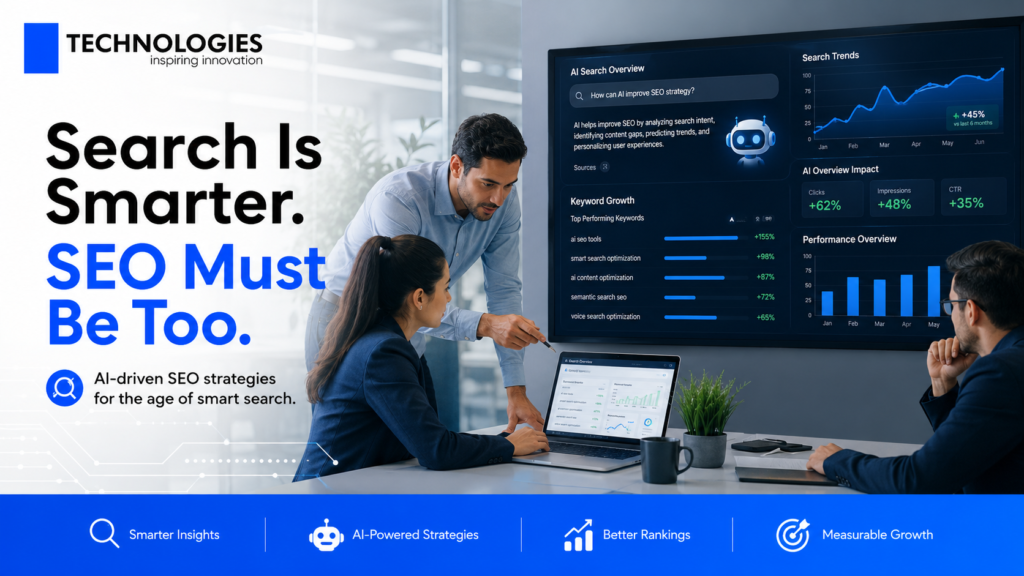
Why SEO Services Are Changing
SEO services used to focus heavily on ranking pages for keywords. That is still important, but modern SEO has become broader.
Today, a good SEO strategy must answer questions like:
Can Google crawl and understand the website?
Does the content answer real customer questions?
Is the information trustworthy and updated?
Does the page show real expertise?
Can AI search tools extract a clear answer from the page?
Does the website cover the full buyer journey?
Are service pages, blogs, FAQs, case studies, and comparison pages connected?
Does the content help users make decisions?
Google’s helpful content guidance recommends creating content for people first, not only for search engines, and encourages original, useful, satisfying content rather than content written only to gain traffic.
This is where many old SEO services fall behind.
Some agencies still offer SEO as a checklist:
Add keywords
Write blogs
Build backlinks
Add meta titles
Submit sitemap
Repeat every month
That kind of SEO may create activity, but it does not always create growth. In smart search, SEO needs to become more strategic, more user-focused, and more connected to business outcomes.
The Biggest Shift: From Keywords to Search Intent
Keywords are not dead. But keyword stuffing is dead.
The real focus now is search intent.
Search intent means understanding what the person really wants when they search.
For example, these keywords may look similar, but the intent is different:
“SEO services”
The user may be exploring.
“SEO services for SaaS companies”
The user has a specific business type.
“Best SEO agency for software companies”
The user may be comparing providers.
“How much do SEO services cost in Canada?”
The user is checking budget.
“Why is my website not ranking on Google?”
The user has a problem and needs diagnosis.
A strong SEO service does not treat all these searches the same. Each one needs a different page, different heading structure, different examples, and different call to action.
In smart search, Google and AI systems try to match the best answer to the searcher’s need. So the content should be built around the question behind the keyword, not just the keyword itself.
AI Search Is Creating More Zero-Click Answers
One major change is that users may get answers directly in search results.
AI Overviews can summarize information above traditional organic listings. That means some users may not click a website if the AI answer already gives them enough information.
This does not mean SEO is finished. It means SEO must change.
A 2026 study on Google AI Overviews found that AI Overviews are changing how information is displayed and how sources are selected, with AI-generated answers often appearing above organic results. Another large measurement study found that AI Overviews appeared more often for question-style queries and that AI-cited sources may differ from regular first-page rankings.
For businesses, the practical lesson is clear:
Do not depend only on simple informational blogs.
If your content only answers basic questions, AI may summarize it. But if your content includes real examples, original insight, service explanations, comparison help, use cases, pricing guidance, local relevance, case studies, and decision-stage information, users still have a reason to visit your website.
What People Search Now: Real Queries SEO Services Must Target
Modern SEO should be built around the exact questions people ask before they choose a service, product, or software.
For SEO services, people commonly search questions like:
How do SEO services work?
What do SEO services include?
How much do SEO services cost?
Why is my website not ranking?
How long does SEO take to show results?
Is SEO better than paid ads?
Do small businesses need SEO?
How do I choose an SEO agency?
What is technical SEO?
How does AI affect SEO?
Can AI content rank on Google?
How do I appear in AI search results?
What is GEO or generative engine optimization?
How do I optimize for Google AI Overviews?
These questions should not be hidden inside one long blog only. They should become part of a full SEO content system.
A business website should have:
Service pages for high-intent visitors
Educational blogs for early-stage users
Comparison pages for decision-stage buyers
Case studies for trust
FAQs for common objections
Technical SEO pages for deeper topics
Local SEO pages for location-based searches
Industry pages for niche targeting
This is how SEO becomes stronger in smart search.
Competitor Gap: What Most SEO Blogs Still Miss
Many competitor blogs about AI and SEO say the same things:
Use AI tools
Write better content
Optimize for voice search
Add schema
Improve E-E-A-T
Focus on user intent
These points are useful, but they are often too general.
The real gap is that many articles do not explain how a business should change its SEO service model.
Here is what many competitors miss:
Gap 1: They Talk About AI Search but Ignore Buyer Journey
AI search affects different stages of the buyer journey differently.
Top-of-funnel content may lose some clicks because AI can summarize basic answers. But bottom-of-funnel pages like service pages, comparison pages, pricing pages, use-case pages, and case studies can still attract serious buyers.
For example, a user may read an AI answer about “what is SEO,” but when they need a company, they still search for:
SEO services for SaaS companies
SEO agency for local businesses
SEO consultant in Canada
SEO audit service
Technical SEO service provider
SEO pricing for small business
So SEO services should not stop at blogs. They should build pages that help people decide.
Gap 2: They Treat GEO as a Replacement for SEO
Generative Engine Optimization, or GEO, is often presented like a completely new thing. But Google’s guidance says traditional SEO foundations still matter for generative AI features in Search. Google specifically mentions crawlability, helpful content, technical requirements, and Search policies as important for AI features too.
So businesses should not panic and throw away SEO.
The better approach is:
Keep technical SEO strong.
Improve content quality.
Write in a clearer answer-first structure.
Add original experience and examples.
Use structured data where relevant.
Build authority across the topic.
Make pages easy for humans and machines to understand.
Smart search is not “SEO vs AI.” It is SEO becoming more advanced.
Gap 3: They Ignore Original Experience
AI can rewrite common information very quickly. That means generic content has less value.
If every website says “SEO improves visibility, traffic, and leads,” that is not enough.
Stronger content includes:
Real examples
Industry-specific pain points
Screenshots or process visuals
Before-and-after explanations
Client problems and solutions
Pricing factors
Mistakes to avoid
Comparison tables
Implementation steps
Expert opinions
Local or niche context
Google’s AI optimization guidance specifically recommends creating non-commodity content that is helpful, reliable, and people-first. That means content should not feel like a copied version of every other article.
Gap 4: They Forget Technical SEO
AI search still depends on accessible content.
If a website is slow, hard to crawl, blocked by robots.txt, full of JavaScript rendering problems, missing internal links, or poorly structured, then even excellent content may not perform well.
Google states that content needs to be crawlable for visibility in generative AI search features because these systems rely on publicly accessible, crawlable content.
So technical SEO is still a foundation, not an old practice.
How SEO Services Should Work in the Age of Smart Search
SEO services now need to combine traditional search optimization with AI-aware content strategy.
A modern SEO service should include the following areas.
1. Technical SEO That Helps Search Engines Understand the Website
Before writing more content, the website must be technically healthy.
Technical SEO includes:
Crawlability
Indexability
Site speed
Mobile usability
Core Web Vitals
Clean URL structure
Internal linking
Canonical tags
Sitemap setup
Robots.txt review
Schema markup
Duplicate content control
404 and redirect management
JavaScript rendering checks
This matters because smart search still needs to access, read, and understand your content.
If your best service pages are buried, slow, or not indexed properly, AI search features and traditional search results may both ignore them.
2. Search Intent Mapping
Search intent mapping means matching keywords to the right page type.
For example:
“what is SEO” = educational blog
“SEO services for small business” = service page
“SEO audit checklist” = guide or downloadable resource
“SEO vs Google Ads” = comparison blog
“technical SEO service” = service landing page
“best SEO agency for SaaS” = industry service page
“SEO pricing in Canada” = pricing guide
This prevents a common SEO mistake: using blogs for every keyword.
Some keywords need blog posts. Some need service pages. Some need comparison pages. Some need case studies. Some need FAQs.
A smart SEO service identifies the right format before writing.
3. Answer-First Content Structure
In AI search, content should answer the main question clearly and early.
This does not mean writing short content only. It means making the page easy to understand.
A good structure includes:
Clear introduction
Direct answer near the top
Searchable H2 and H3 headings
Short paragraphs
Practical examples
Definitions when needed
Tables where helpful
FAQs
Internal links
Strong conclusion
Clear next step
This helps both readers and search systems.
If a page hides the answer under long generic paragraphs, users leave. Smart search systems also have less clear information to extract.
4. Topical Authority Instead of Random Blogging
Publishing random blogs is not a strategy.
A website should build topical authority by covering a subject deeply and logically.
For example, an SEO services website could build clusters around:
Technical SEO
Local SEO
SaaS SEO
Ecommerce SEO
AI and SEO
SEO audits
Content strategy
Link building
Website ranking issues
Google Business Profile SEO
SEO vs paid ads
SEO pricing
SEO for different industries
Each cluster should have a main pillar page and supporting articles.
This helps Google understand that the website is not just posting occasional SEO content. It is building expertise around the topic.
5. Original Data, Examples, and Experience
Smart search rewards clarity and usefulness. But users also need proof.
A strong SEO page should include:
Real business examples
Specific pain points
Screenshots where possible
Step-by-step processes
Mini case studies
Expert notes
Common mistakes
Practical recommendations
Local market context
Industry-specific details
For example, instead of saying:
“SEO helps SaaS companies get more leads.”
Say:
“A SaaS company should not only target ‘project management software.’ It should also build pages for ‘project management software for agencies,’ ‘Asana alternative for client onboarding,’ ‘best project tracking tool for remote teams,’ and ‘project management software pricing.’ These keywords may have lower traffic, but they attract buyers who are already comparing solutions.”
This kind of content is harder to replace with generic AI output.
6. SEO for AI Overviews and AI Assistants
Optimizing for AI search does not mean using tricks. It means making your content easier to trust, understand, and cite.
Practical steps include:
Write clear definitions.
Use question-based headings.
Answer directly before expanding.
Add examples and explanations.
Mention limitations honestly.
Keep pages updated.
Use structured data where relevant.
Make author or company expertise visible.
Avoid vague claims.
Cite reliable sources when making research-based claims.
Build strong internal links.
Make pages crawlable.
Google’s AI features guidance says the same fundamental SEO practices apply to AI features as normal Search, including meeting technical requirements and focusing on helpful, reliable, people-first content.
So the goal is not to “game AI.” The goal is to become the clearest and most trustworthy answer.
How AI Tools Are Changing SEO Services
AI tools can help SEO teams work faster, but they should not replace strategy.
AI can help with:
Keyword grouping
Content outlines
Topic research
Competitor comparison
Meta title ideas
FAQ ideas
Content refreshing
Internal linking suggestions
Technical issue summaries
Analytics interpretation
Schema suggestions
Search intent classification
But AI should not blindly write final content without human review.
Google’s guidance says AI-generated content is not automatically against its rules, but using automation to generate many pages without adding value may violate spam policies.
This is important for businesses.
AI can support SEO, but human strategy is still needed for:
Brand voice
Customer understanding
Real examples
Expert opinion
Accuracy checking
Content quality
Competitive positioning
Trust-building
Conversion strategy
The best SEO services now use AI as an assistant, not as a shortcut.
Does AI Content Rank on Google?
Yes, AI-assisted content can rank if it is helpful, accurate, original, and made for people.
But low-quality AI content is risky.
The issue is not whether AI was used. The issue is whether the page provides real value.
A weak AI SEO article usually has:
Generic wording
Repeated ideas
No examples
No original insight
No expert review
No clear audience
No real solution
No trust signals
No updated information
No reason to choose that page over others
A strong AI-assisted article has:
Human editing
Clear search intent
Accurate facts
Real examples
Useful structure
Original analysis
Brand-specific context
Helpful visuals
Internal links
External citations when needed
A clear next step
That is the difference between AI content and AI-supported expert content.
How Smart Search Affects Local SEO
AI search does not only affect blogs. It also affects local businesses.
People now search in more specific ways:
Best SEO agency near me for small business
Digital marketing company in Toronto for startups
Website development and SEO services near me
Local SEO consultant for Google Maps ranking
SEO company with experience in healthcare clinics
Local SEO services should focus on:
Google Business Profile optimization
Local landing pages
Reviews
Service-area pages
Local citations
Local schema
Location-specific FAQs
Photos and service proof
Local case studies
Consistent NAP details
Website content connected to local intent
AI-powered search may summarize local options, but strong local signals still matter because users want businesses they can trust.
How Smart Search Affects SaaS and B2B SEO
For SaaS and B2B companies, smart search increases the importance of high-intent pages.
A SaaS buyer does not only search “CRM software.” They search:
Best CRM for small B2B teams
HubSpot alternative for agencies
CRM with Slack integration
CRM pricing for startups
CRM vs project management software
How to automate lead follow-up in CRM
This means SaaS SEO services should build:
Use-case pages
Integration pages
Comparison pages
Alternative pages
Pricing guides
Industry pages
Security pages
Product-led blogs
Case studies
Smart search may answer simple definitions, but buyers still need specific product evaluation content before making a decision.
How Smart Search Affects Ecommerce SEO
Ecommerce search is also becoming more conversational.
Instead of searching only “running shoes,” users may ask:
Best running shoes for flat feet under £100
Waterproof hiking shoes for winter walking
Best laptop for students with long battery life
Affordable skincare products for sensitive skin
Ecommerce SEO services should focus on:
Product category optimization
Buying guides
Comparison content
Product FAQs
Schema markup
Review content
Image SEO
Page speed
Filter and faceted navigation control
Internal linking
Unique product descriptions
User-generated content
Smart search makes buyer guidance more important. Ecommerce websites need to help customers choose, not just list products.
What Businesses Should Stop Doing in SEO
Smart search makes old shortcuts weaker.
Businesses should stop:
Publishing thin AI blogs at scale
Writing only for keyword volume
Copying competitor outlines without adding insight
Ignoring technical SEO
Using generic service pages
Publishing blogs with no internal links
Avoiding pricing or process questions
Ignoring FAQs from sales calls
Overusing exact-match keywords
Writing content without a clear buyer stage
Treating SEO and conversion separately
These habits may create content, but not authority.
What Businesses Should Start Doing Instead
A better smart-search SEO strategy includes:
Writing for real customer questions
Creating original, experience-based content
Building strong service pages
Adding comparison and decision-stage content
Improving technical SEO
Using internal links strategically
Updating old content
Adding FAQs based on search queries
Using schema where useful
Making content easy to quote, summarize, and trust
Connecting SEO with leads, sales, and revenue
This is how SEO becomes a growth system instead of just a traffic channel.
A Practical SEO Services Roadmap for Smart Search
Here is a simple roadmap businesses can follow.
Step 1: Audit the Website
Check technical SEO, rankings, content quality, page speed, internal links, and indexing issues.
Step 2: Map Search Intent
Group keywords by awareness, consideration, decision, and post-purchase support.
Step 3: Build Core Service Pages
Create detailed, useful pages for each main service, location, industry, or product category.
Step 4: Create Helpful Content Clusters
Write connected content around real buyer questions, not random topics.
Step 5: Add Decision-Stage Pages
Create comparison pages, pricing guides, alternatives, use cases, and FAQs.
Step 6: Improve Trust Signals
Add case studies, testimonials, author details, process explanation, screenshots, and examples.
Step 7: Optimize for AI Search Readability
Use clear headings, direct answers, structured information, fresh content, and crawlable pages.
Step 8: Track Business Results
Measure leads, demo requests, calls, form submissions, qualified traffic, and revenue impact — not only rankings.
SEO Services in the Age of AI: What Clients Should Expect
Businesses hiring an SEO agency today should expect more than blog writing.
A modern SEO service should provide:
Technical SEO audits
Keyword and intent research
Content strategy
Service page optimization
AI-search-aware content structure
Conversion-focused landing pages
Internal linking strategy
Competitor gap analysis
Local SEO support where needed
Analytics and reporting
Content updates
Authority-building recommendations
Clear business KPIs
If an SEO provider only talks about “monthly blogs and backlinks,” that may not be enough for smart search.
Where ZA Technologies Fits Into AI and SEO Services
AI and SEO now sit closer together than ever.
A business needs content that can rank, but it also needs a website that is technically strong, fast, clear, and conversion-focused. It may also need AI-powered workflows, better analytics, landing pages, content systems, and digital strategy.
ZA Technologies can position its SEO services around this bigger opportunity: helping businesses become visible in traditional search and smart search while building websites and digital systems that turn visitors into leads.
For strong internal linking, this blog should naturally link to:
SEO Services page
Digital Marketing or growth service page
Website Development page
Software Development page
AI Chatbots and Agents page
Workflow Automation page
Contact Us page
This connects the blog with ZA Technologies’ broader digital and AI services.
Final Thoughts
SEO is not disappearing because of AI. It is becoming more demanding.
The businesses that relied on thin content, keyword stuffing, and generic blogs will struggle more. But businesses that create helpful, trustworthy, well-structured, experience-based content still have a strong opportunity.
Smart search rewards clarity.
It rewards usefulness.
It rewards authority.
It rewards real answers.
It rewards websites that are easy to crawl, understand, and trust.
AI can summarize simple answers, but customers still need deeper guidance before choosing a company, service, software, or product.
That is where modern SEO services matter.
The future of SEO is not only ranking for keywords. It is becoming the best answer across Google, AI search, local search, product search, and buyer decision journeys.
Businesses that understand this shift early will have a stronger chance to win visibility, trust, and high-quality leads in the age of smart search.