

Launching a new digital product creates an uncomfortable question for almost every startup founder:
Should we build a Minimum Viable Product first, or invest directly in a complete product?
Building too little can leave users unimpressed. Building too much before validating demand can consume months of development effort and a large part of your budget on features customers may never use.
That is why understanding MVP Development vs Full Product Development matters before hiring developers, choosing technology or finalizing your product roadmap.
An MVP allows you to test your core idea with a focused version of the product. Full product development aims to deliver a broader, more polished solution with advanced functionality from the beginning.
Neither approach is automatically better.
The right choice depends on your market, product complexity, available budget, business risk and—most importantly—what you still need to learn about your customers.
This guide explains the difference and helps you decide which development strategy makes sense for your startup.
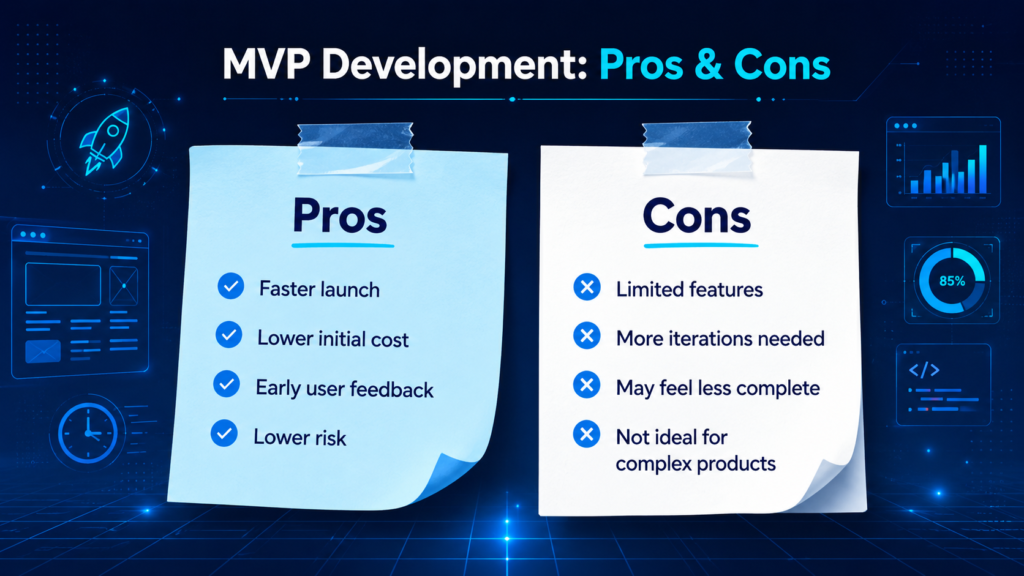
What Is MVP Development?
MVP development means building the smallest useful version of a product that solves one important customer problem and can be tested with real users.
The word “minimum” is often misunderstood.
An MVP should not mean:
- Poor design
- Broken functionality
- Unreliable software
- Randomly removing important features
- Launching an unfinished product
A good MVP is deliberately focused.
Instead of trying to solve ten customer problems at once, it solves the most important one well enough to test whether people actually want the solution.
Imagine you want to build a platform connecting homeowners with local maintenance professionals.
A full vision might eventually include:
- Service provider profiles
- Real-time availability
- Online payments
- Live chat
- Reviews
- Subscription plans
- AI recommendations
- Loyalty rewards
- Advanced analytics
- Multiple languages
Your first MVP may only require:
- User registration
- Service search
- Provider profiles
- Booking requests
- Basic payment functionality
Those features may be enough to answer the most important early question:
Will customers actually use the platform to book local professionals?
That is the purpose of startup MVP development.
What Is Full Product Development?
Full product development focuses on building a more complete version of your envisioned solution before a wider market launch.
Instead of validating only the core concept, the development team may build several interconnected workflows, user roles, integrations and supporting features.
A full digital product could include:
- Complete user onboarding
- Advanced dashboards
- Payment systems
- Admin controls
- Notifications
- Third-party integrations
- Reporting
- Security controls
- Automation
- Personalization
- Mobile applications
- Customer support functionality
- Multiple subscription plans
- Analytics infrastructure
Full product development normally requires more planning because decisions made in one part of the system can affect many others.
This approach can make sense when the market need is already proven, the product requirements are well understood or a minimal solution would not provide enough value to users.
MVP Development vs Full Product Development: Key Differences
Here is a simple comparison.
| Area | MVP Development | Full Product Development |
|---|---|---|
| Primary Goal | Validate the product idea | Deliver a complete solution |
| Feature Scope | Core features only | Broad feature set |
| Initial Investment | Lower | Higher |
| Launch Speed | Usually faster | Usually longer |
| User Feedback | Collected early | Often collected after more development |
| Flexibility | Easier to change direction | Changes may be more expensive |
| Risk | Limits early investment risk | Greater investment before validation |
| Best For | New or unvalidated ideas | Proven or clearly defined products |
| Development Approach | Learn and iterate | Build toward defined requirements |
The biggest difference is not simply the number of features.
It is when you choose to learn from the market.
An MVP puts learning earlier in the development process.
Full product development puts more emphasis on preparation and execution before broad market feedback.
Why Many Startups Begin With an MVP
Startups operate with uncertainty.
You may believe customers want your product, but several assumptions remain untested:
- Will they sign up?
- Will they use the core feature?
- Will they pay?
- Which feature matters most?
- Why would they switch from an existing solution?
- How frequently will they return?
- What will stop them from completing a purchase?
A pitch deck cannot answer these questions.
Real users can.
That is why MVP development can be valuable.
1. You Validate Demand Before Scaling
One of the biggest startup risks is building a product customers do not care enough about.
An MVP allows you to place a working solution in front of users and observe what actually happens.
There is a major difference between someone saying:
“That sounds like a great idea.”
and someone actually:
- Creating an account
- Completing onboarding
- Using the product
- Returning later
- Paying for it
- Recommending it
Real behavior provides better evidence than assumptions.
2. You Can Learn Which Features Matter
Founders often begin with long feature lists.
Users frequently have different priorities.
After launching an MVP, you might discover that one simple feature generates most of the product’s value while several planned features receive very little interest.
This information can reshape your roadmap.
Instead of deciding features based on internal opinions, you can prioritize development using actual product usage and customer feedback.
3. You Can Reach the Market Earlier
Every additional feature adds work.
More features usually mean more:
- Design
- Development
- Testing
- Integrations
- Edge cases
- Documentation
- Deployment preparation
An MVP narrows the first release to essential functionality.
That can help startups reach users earlier and begin learning while competitors may still be planning a much larger launch.
4. You Reduce the Cost of Being Wrong
Changing a concept during a prototype stage is relatively simple.
Changing a large platform after months of development can be much harder.
Imagine spending significant resources building:
- Five user roles
- Complex reporting
- Custom dashboards
- Multiple payment models
- An advanced recommendation engine
Then customers reveal that the core workflow itself does not solve their problem.
The technical work may be excellent, but the business assumption was wrong.
MVP development reduces how much you invest before testing those assumptions.
When Full Product Development Makes More Sense
MVP development is useful, but it should not be treated as a universal rule.
There are situations where starting with a broader product can be reasonable.
1. Your Business Model Is Already Proven
Suppose you already operate the service manually and have hundreds of paying customers.
You understand:
- Customer needs
- Buying behavior
- Pricing
- Workflows
- Common problems
Now you want to turn that proven service into software.
You are not testing whether the problem exists.
You are primarily building technology to serve an existing demand.
A more complete product may therefore make sense.
2. Customers Expect a Certain Minimum Feature Set
Some markets have established expectations.
For example, users of a serious business management platform might expect:
- Authentication
- Permissions
- Reporting
- Integrations
- Notifications
- Data exports
- Security controls
If you launch something dramatically below market expectations, users may reject it even if your underlying idea is strong.
Your “minimum viable” product still needs to be genuinely viable.
3. The Product Is Being Built for an Existing Organization
Established businesses often have clearer requirements than early-stage startups.
A company replacing an outdated internal system might already know:
- User roles
- Workflows
- Reporting requirements
- Approval processes
- Integrations
- Security requirements
In that situation, full product development can be more appropriate than testing whether employees need the system at all.
4. Your Product Has Important Dependencies
Some products cannot deliver meaningful value without several systems working together.
For example, a platform may require:
- Identity verification
- Payments
- Logistics
- Customer dashboards
- Admin controls
- Notifications
Removing one component may make the entire experience unusable.
The MVP must therefore include enough infrastructure to make the core experience complete.
MVP Does Not Mean Building a Cheap Version of Everything
This is one of the most damaging MVP mistakes.
Suppose your final platform requires 20 features.
Some teams try to create weak versions of all 20 and call that an MVP.
That usually produces a confusing product.
A better strategy is:
Build fewer features, but make the important ones work properly.
For example:
Weak MVP
- Basic chat
- Basic analytics
- Basic payments
- Basic recommendations
- Basic profiles
- Basic subscriptions
- Basic reporting
- Basic automation
Everything exists, but nothing feels reliable.
Focused MVP
- Excellent onboarding
- Strong core workflow
- Reliable payment
- Simple user dashboard
The focused version provides a better test because customers can actually experience the product’s main value.
How Much Should You Build in an MVP?
The right question is not:
“How few features can we build?”
Ask:
“What is the smallest product that can test our most important business assumption?”
For a marketplace, the assumption might be:
Buyers are willing to book providers through our platform.
For SaaS software:
Businesses will pay to automate this workflow.
For an AI application:
Users find AI-generated recommendations valuable enough to return regularly.
For a delivery app:
Customers will order from local stores through a single digital platform.
Your MVP features should directly support testing that assumption.
Anything that does not help validate the core value proposition can potentially wait.
7 Questions to Ask Before Choosing MVP or Full Product Development
Before hiring an MVP development company or committing to full-scale development, answer these questions.
1. Has the Problem Already Been Validated?
If you are still unsure whether customers strongly experience the problem, start small.
An MVP gives you room to learn.
If you already have paying customers requesting the product, broader development may be justified.
2. Do You Know Which Features Users Actually Need?
A 40-feature roadmap built entirely on assumptions creates significant uncertainty.
When feature priorities are unclear, MVP development allows customers to influence the roadmap.
3. How Much Can You Afford to Learn the Hard Way?
Every startup makes incorrect assumptions.
The question is how expensive those mistakes become.
The more uncertainty you have, the more valuable an iterative approach becomes.
4. How Quickly Do You Need Market Feedback?
If investors, stakeholders or your internal team need evidence of real demand, launching a focused MVP can provide meaningful data earlier.
5. Are There Regulatory or Security Requirements?
Some products require extensive security, compliance or operational controls before they can responsibly launch.
These requirements should never be removed simply to make an MVP cheaper or faster.
6. Would a Basic Version Still Solve the User’s Problem?
If yes, an MVP may work well.
If removing advanced functionality destroys the product’s value, you may need a larger first release.
7. What Is the Goal of Version One?
This question often resolves the entire debate.
Is version one designed to:
Learn?
Build an MVP.
Is it designed to:
Serve a known, proven requirement at scale?
A more complete product may be appropriate.
What Should Be Included in an MVP?
Although every project is different, a well-planned MVP generally includes four layers.
Core User Experience
Users must be able to complete the primary task your product exists to solve.
Essential Backend Functionality
The system must securely store, process and retrieve the information necessary for the main experience.
Basic Analytics
Without analytics, you may launch an MVP but learn very little.
Track meaningful actions such as:
- Registrations
- Onboarding completion
- Feature usage
- Conversion
- Retention
- Purchases
- Drop-off points
Feedback Mechanisms
Give early users an easy way to tell you:
- What confused them
- What they liked
- What they expected
- What they need next
Your first users should help shape your second version.
Common MVP Development Mistakes Startups Should Avoid
Choosing an MVP strategy does not automatically reduce risk.
Poor execution can create new problems.
Building Too Many Features
If everything is “essential,” nothing has actually been prioritized.
Focus on the workflow that demonstrates your core value proposition.
Ignoring UX Because It Is “Only an MVP”
Users do not care what phase of development you are in.
If they cannot understand how to use the product, you cannot accurately measure whether they value the concept.
Choosing Technology Only for Speed
Fast development matters, but version one should not create unnecessary technical barriers to version two.
Your development team should understand both the MVP and the likely future roadmap.
Launching Without Analytics
If you do not track what users do, you lose one of the biggest benefits of MVP development.
Treating the MVP as the Finished Product
An MVP is the beginning of a learning cycle.
The typical process is:
Build → Launch → Measure → Learn → Improve
Your roadmap should evolve based on what happens after launch.
Can an MVP Grow Into a Full Product?
Yes—when it is built with future growth in mind.
A good MVP development strategy balances two priorities:
Do not overbuild today.
But also:
Do not make tomorrow unnecessarily difficult.
That means thinking about:
- Product architecture
- Data structure
- Security
- API design
- Scalability
- Code quality
- Infrastructure
- Future integrations
You do not need to build every future feature.
But your technical decisions should consider where the product is likely to go next.
MVP Development vs Prototype: They Are Not the Same
These terms are also frequently confused.
A prototype demonstrates how a product might work.
An MVP is a usable product that allows you to test real market behavior.
A prototype may include:
- Clickable screens
- User flows
- Interface concepts
- Simulated functionality
It can help answer:
Can users understand this experience?
An MVP helps answer:
Will users actually use and value this product?
Many startups benefit from building a prototype before beginning MVP development.
This gives the team an opportunity to identify UX problems while changes are still relatively inexpensive.
A Smarter Startup Product Development Process
Rather than immediately choosing between “small product” and “big product,” consider a staged process.
Stage 1: Market Research
Understand:
- Customer problems
- Competitors
- Existing alternatives
- Buying behavior
- Market gaps
Stage 2: Define Product Goals
Clarify exactly what the product needs to accomplish.
Stage 3: Identify Target Users
Different customers may have completely different expectations.
Know who version one is being built for.
Stage 4: Create Wireframes and Prototype
Test your assumptions before writing significant amounts of production code.
Stage 5: Develop the MVP
Build the smallest reliable product that delivers your core value proposition.
Stage 6: Launch and Measure
Track user behavior instead of relying only on opinions.
Stage 7: Improve Based on Evidence
Prioritize the next features using:
- Usage data
- Customer interviews
- Support requests
- Conversion data
- Retention
- Business impact
Stage 8: Scale Toward the Full Product
Once the concept is validated, invest with greater confidence in advanced features and infrastructure.
This creates a much more disciplined route from idea to scalable digital product.
MVP Development or Full Product Development: Which Should You Choose?
Choose MVP Development when:
- Your product idea is new
- Customer demand is uncertain
- Feature priorities are unclear
- You need real user feedback
- You want to validate before scaling
- You need evidence before a larger investment
Choose Full Product Development when:
- Demand is already proven
- Product requirements are well understood
- Existing customers are requesting the solution
- A limited version would not provide meaningful value
- You have established workflows and requirements
- The product must support a complete operational process from launch
For many startups, the safest path is not choosing between an MVP and a full product forever.
It is using an MVP as the first stage of full product development.
Build enough to validate.
Learn from users.
Then invest more confidently in what deserves to be built next.
Final Thoughts
The biggest product development mistake is not choosing MVP Development instead of Full Product Development—or vice versa.
It is committing heavily to development without understanding what needs to be validated first.
A strong startup does not measure progress by the number of features developed.
It measures progress by how much uncertainty has been removed.
If your biggest questions are still about customer demand, product-market fit or feature priorities, MVP development can give you answers before you make a larger investment.
If your demand, workflows and requirements are already proven, full product development may help you move directly toward a complete market-ready solution.
The right development strategy starts with your business risk, not your feature list.
Planning a new digital product? Talk to our product development team to define the right MVP, validate your roadmap and build a scalable foundation for growth.
Frequently Asked Questions
Is an MVP better than a full product for startups?
An MVP is often better when a startup still needs to validate demand, customer behavior or feature priorities. A full product may be suitable when requirements and market demand are already clearly established.
What is the main purpose of MVP development?
The main purpose of MVP development is to launch the smallest useful version of a product that can test important business assumptions with real users.
Can I turn an MVP into a full product later?
Yes. A well-built MVP can become the foundation for a larger product. Features can be added based on user feedback, analytics and changing business priorities.
Is an MVP the same as a prototype?
No. A prototype demonstrates how a product could work, while an MVP is a functional product that real customers can use.
Should startups build every important feature in their MVP?
No. Startups should prioritize features required to deliver and validate the product’s core value. Additional functionality can be developed after learning from real users.
When should a startup skip an MVP?
A startup may choose a broader initial product when demand is already proven, requirements are clear, or the solution cannot provide meaningful value without a larger set of interconnected features.
How do I decide which features belong in my MVP?
Start with the most important customer problem and business assumption. Include the functionality necessary to solve that problem and measure whether users value the solution.