
FOR MINING EXPLORATION TEAMS
Your next drill result is only as good as the data behind it.
QAQC validates your assay data the way a diligence team will. Every sample is checked, insertion compliance is verified, over limit samples are flagged, and you get a clear verdict your Qualified Person can stand behind.
Live demo runs about fifteen minutes, on real console screens with demonstration data.
Where assay quality quietly fails.
None of these need a bigger team or a longer day. They need the checking done properly, every time, before the results are used.
Checking by spreadsheet.
Assay files arrive from the lab and are checked by hand, formula by formula. It works until the one month it does not, and nobody can prove which month that was.
Insertion gaps.
Standards, blanks and duplicates are supposed to travel with your samples. When insertion slips, the results still arrive, and they look exactly like good results.
Failures found late.
A failed standard found during a site visit is a conversation. The same failure found by a buyer during diligence, or inside a technical report, is a valuation problem.
Over limit samples lost in the file.
Samples above detection limits need re assay. Buried in a spreadsheet of thousands of rows, they are the easiest samples in the program to miss.
No evidence trail.
When someone asks how the data was checked, the answer is a person and a memory. Diligence teams, auditors and regulators want records, not recollections.
QP time spent on data entry.
Your Qualified Person should be interpreting geology. Instead their hours go to cleaning files and chasing certificates before they can sign anything.
Every feature, on real screens.
These are the actual QAQC console screens, captured on demonstration data. This is exactly what your team will see.
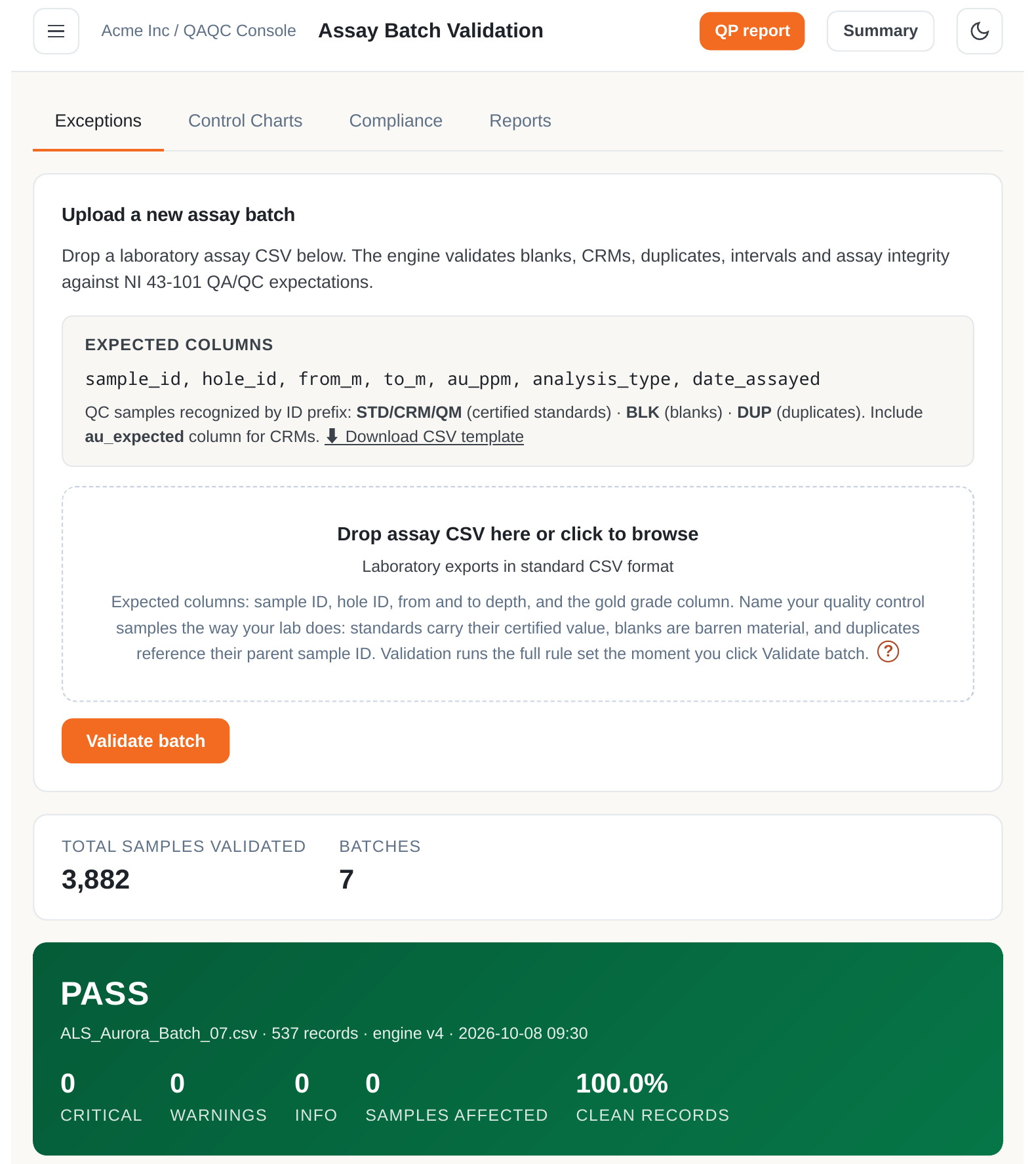
The console.
Every validation run in one place, with its status and its verdict. Open the platform and the state of your data quality is on the first screen.
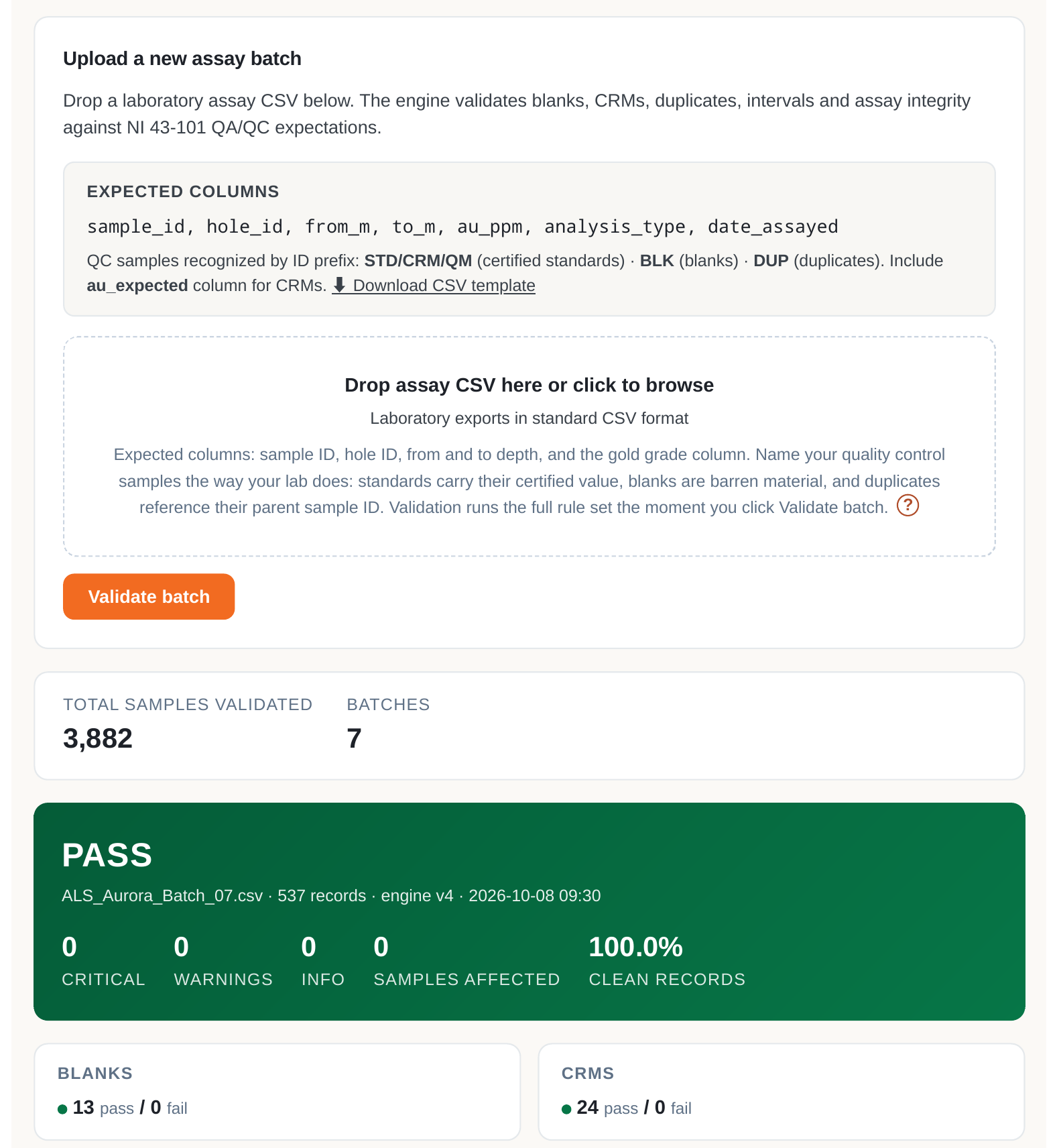
Run a validation.
Load the assay file your lab sent and run the full check set against it. Sample counts, check results and failures are summarised on one screen.
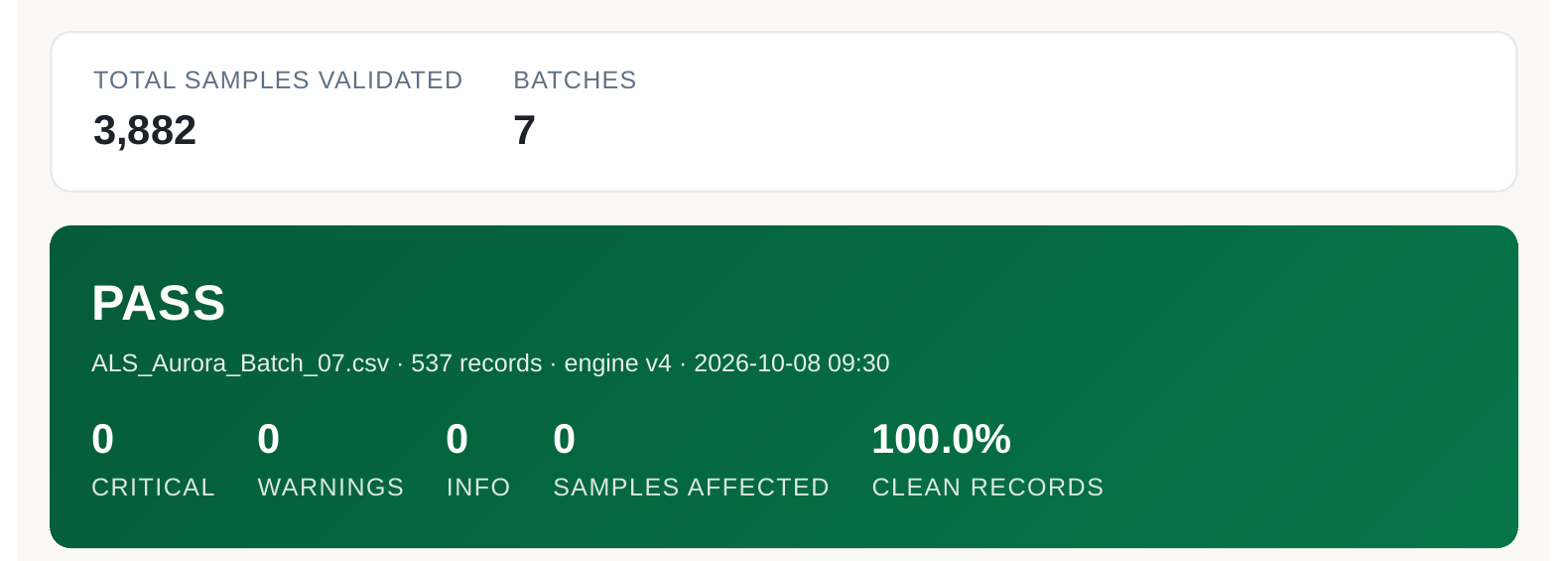
The verdict.
Every run ends in a clear verdict, pass or fail, with the reasons behind it. No interpretation needed before you act, and no bad batch slips through quietly.
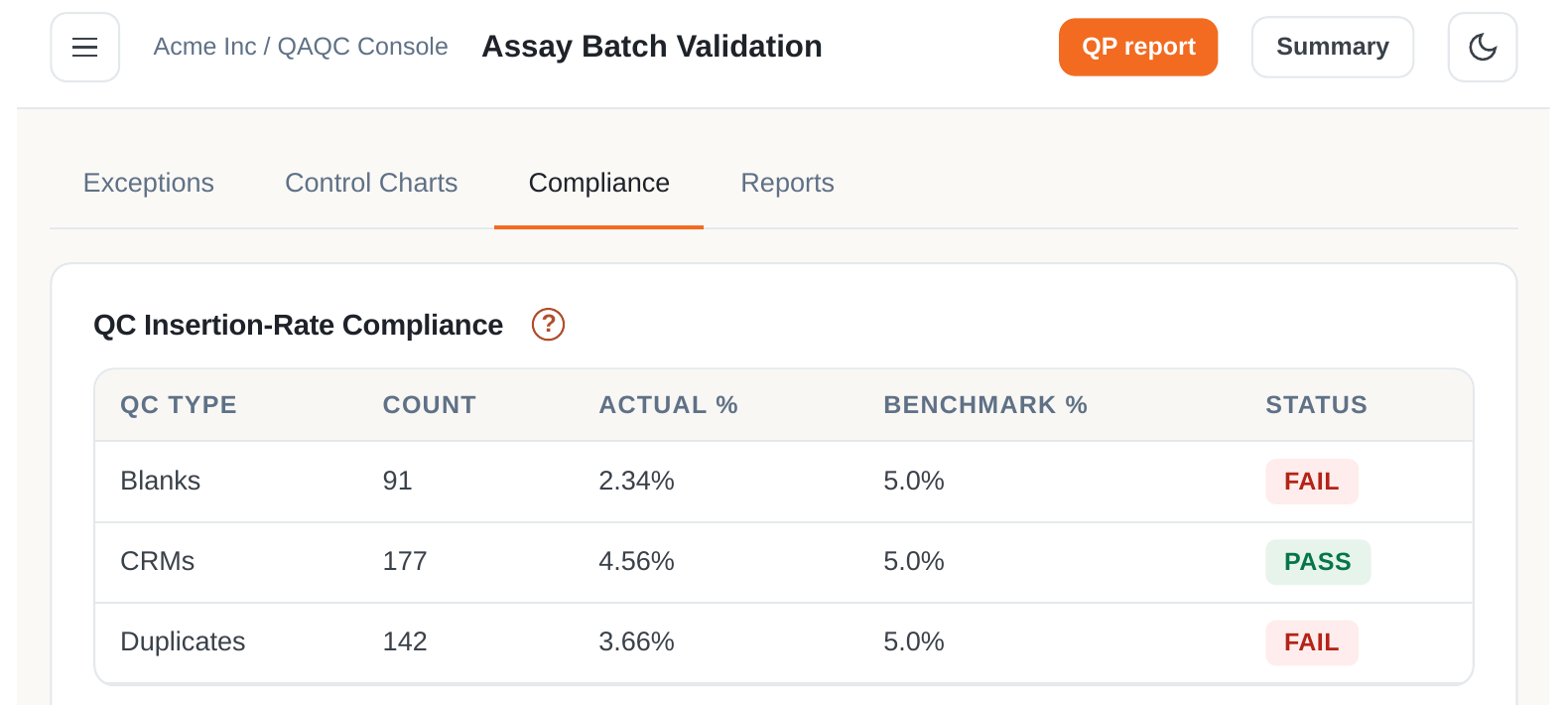
Insertion compliance.
Standards, blanks and duplicates are tracked against what your program requires. Insertion compliance is shown plainly, so a gap is visible the week it happens.
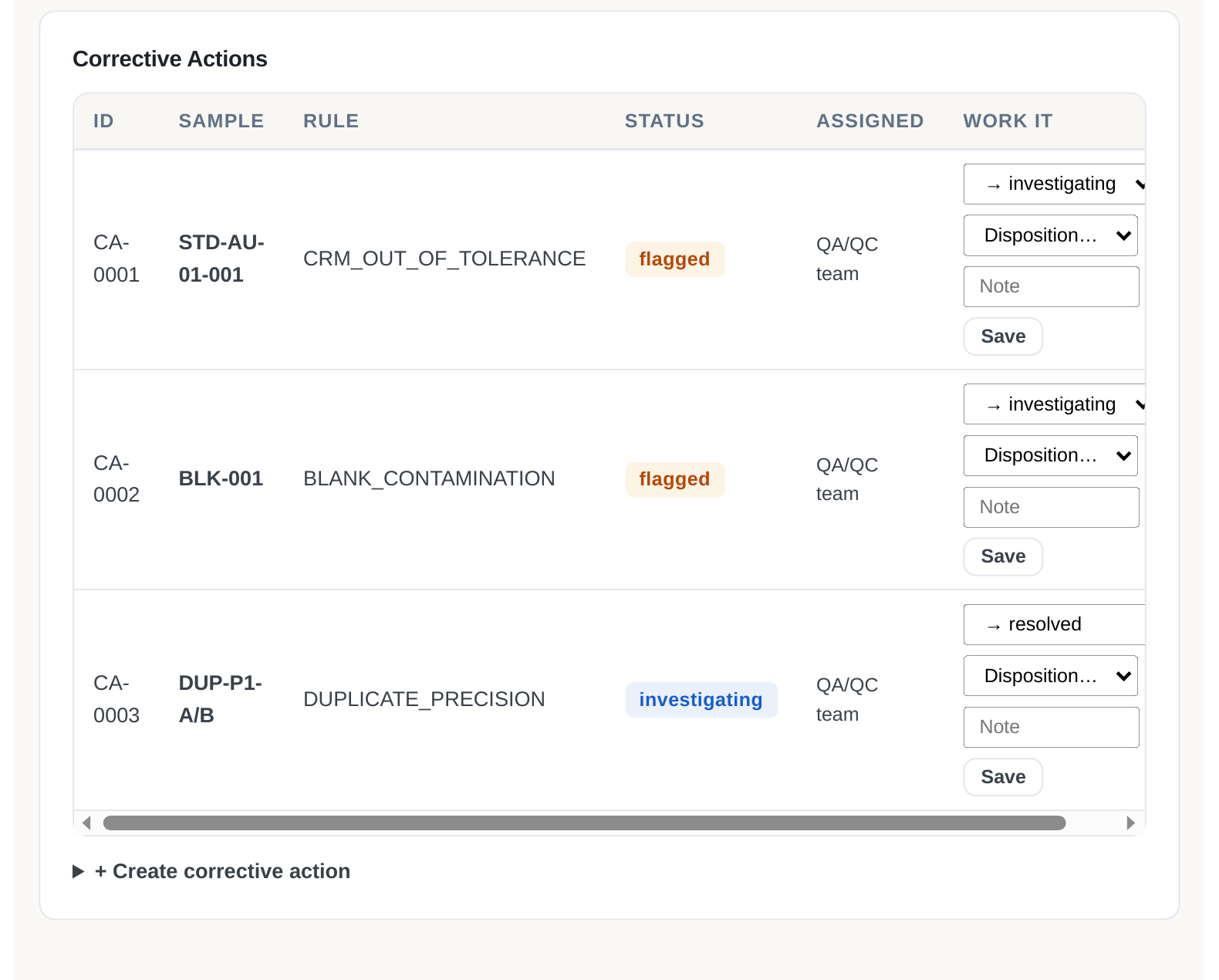
Flagged samples.
Over limit samples and failed checks are listed for review, sample by sample, with the reason each one was flagged. Nothing hides inside the file.
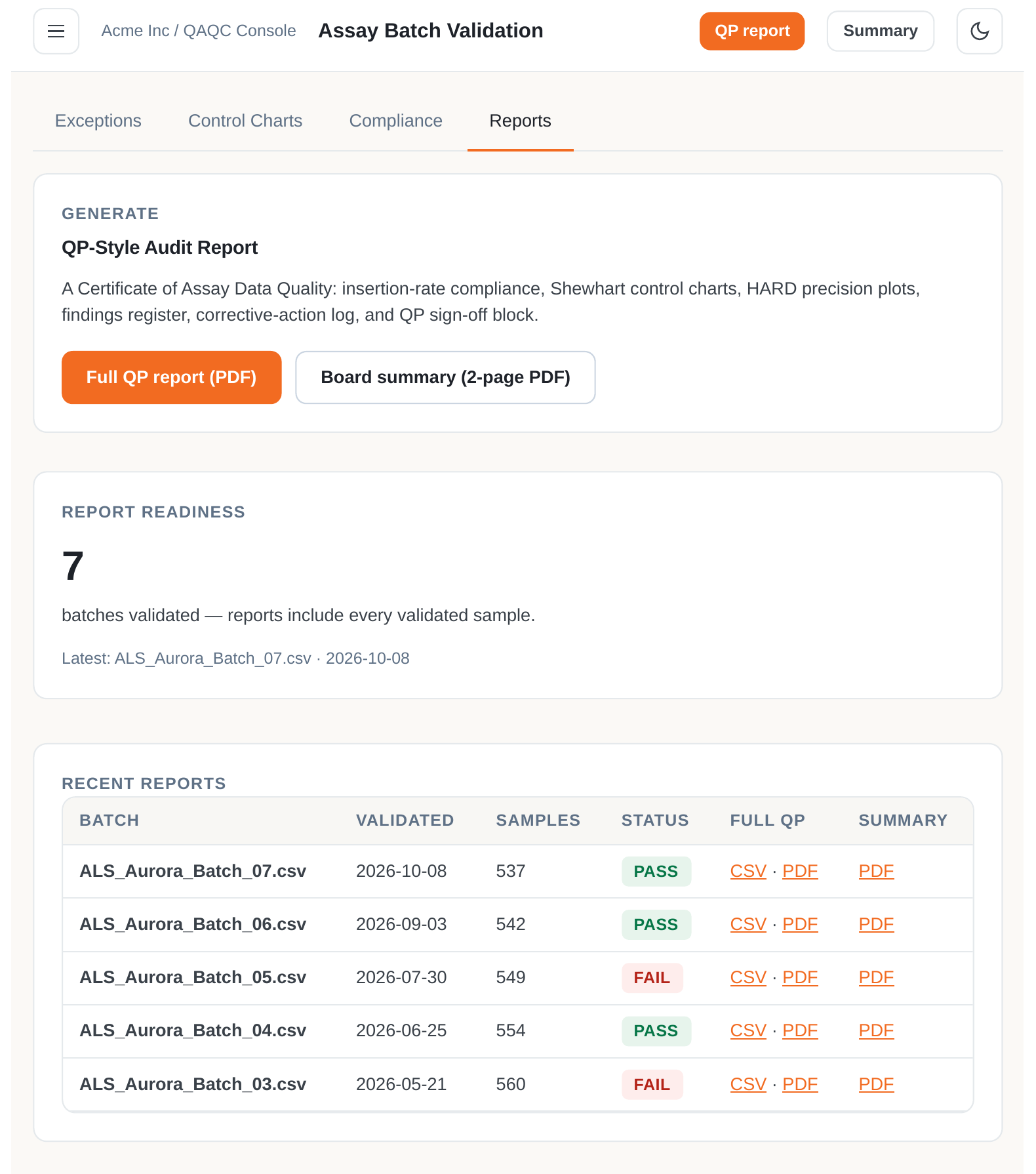
The report.
Each run produces a report you can file with the project record, hand to your Qualified Person, or place in a data room when diligence comes.
Watch a full run.
This recording is a real session on the QAQC console with demonstration data: the console and its validation runs, a completed run and its verdict, the flagged samples listed with their reasons, and the report ready for the project file. About ninety seconds, with captions, because most people watch with the sound off.
Three steps between the lab file and the verdict.
Send the file.
Your lab results arrive as they always do. The file goes into QAQC as it came, with no reformatting project before you can start.
QAQC validates.
The full check set runs across every sample: insertion compliance, standards performance, blanks, duplicates and over limit values.
You get the verdict and the report.
A clear pass or fail on screen, the flagged samples listed with reasons, and a report ready for the project file and your Qualified Person.
What QAQC checks on every run.
The checks a careful diligence team would run, run the same way every time.
- Every sample in the file accounted for, in sequence
- Standards performance against their certified values
- Blanks checked for contamination
- Duplicates checked for precision
- Insertion compliance for standards, blanks and duplicates
- Over limit samples flagged for re assay
- Failed checks listed sample by sample, with reasons
- A verdict and a filed report on every run
The list is fixed on purpose. The same checks, the same way, on every file, so results can be compared across a whole drill program.
Checked by hand, or checked by system.
The old way.
- Assay files checked in spreadsheets, when time allows.
- Insertion tracked from memory and delivery notes.
- A failed standard found weeks later, or by someone else.
- Over limit samples spotted only if a row catches an eye.
- When diligence asks how data was checked, the answer is a person.
With QAQC.
- Every file validated in full, the same way every time.
- Insertion compliance measured and shown on screen.
- Failures flagged on the day the file arrives.
- Every over limit sample listed for re assay.
- A filed report answers the diligence question before it is asked.
Built for the people who sign off on the data.
Exploration teams at junior miners.
Drill programs move fast and the data has to keep up. QAQC gives a small team the checking discipline of a much larger one.
Qualified Persons.
The QP still interprets and still signs. QAQC hands them validated data and a filed evidence trail instead of a cleaning job.
Teams facing diligence.
Raising money, selling a project or filing a technical report all end in the same room, with someone checking your data. Arrive with the reports already done.
Start with the audit. Stay for the system.
Most teams meet QAQC through the audit. The subscription keeps every new batch of results validated as the program runs.
Mining Diligence Audit
CAD 15,000, one time
- Your assay database run through the full QAQC check set
- Insertion compliance, standards, blanks and duplicates reviewed
- Over limit and failed samples listed with reasons
- A written report of what diligence will find, before diligence finds it
Subscription tiers are confirmed with ZA Technologies before any subscription starts. Invoices are due on receipt with a 10 day grace period. No interest and no late fees, ever.
Questions exploration teams ask.
What does QAQC need from us to start?
Your assay result files as the lab issued them, and the list of standards your program uses. The audit begins from the data you already have.
Does QAQC replace our Qualified Person?
No. Your Qualified Person interprets the geology and signs the disclosure, exactly as before. QAQC validates the data underneath their work and keeps the evidence trail, so their time goes to judgement instead of file cleaning.
What happens when samples are flagged?
Each flagged sample is listed with the reason it was flagged, so your team can re assay, investigate or document the decision. The flag and the outcome both stay on the run record.
Our data is commercially sensitive. Who sees it?
Your data is yours. It is used only to run your validations and produce your reports, and your project data is never shared with another client or used in anyone else material.
Can QAQC handle a full historical database, not just new files?
Yes. The Mining Diligence Audit is built for exactly that: a complete historical assay database checked in full, with a written report at the end.